

Patek Philippe Walked Away From a 120-Year-Old Standard and Wrote a Stricter One. Here's What That Actually Automates.

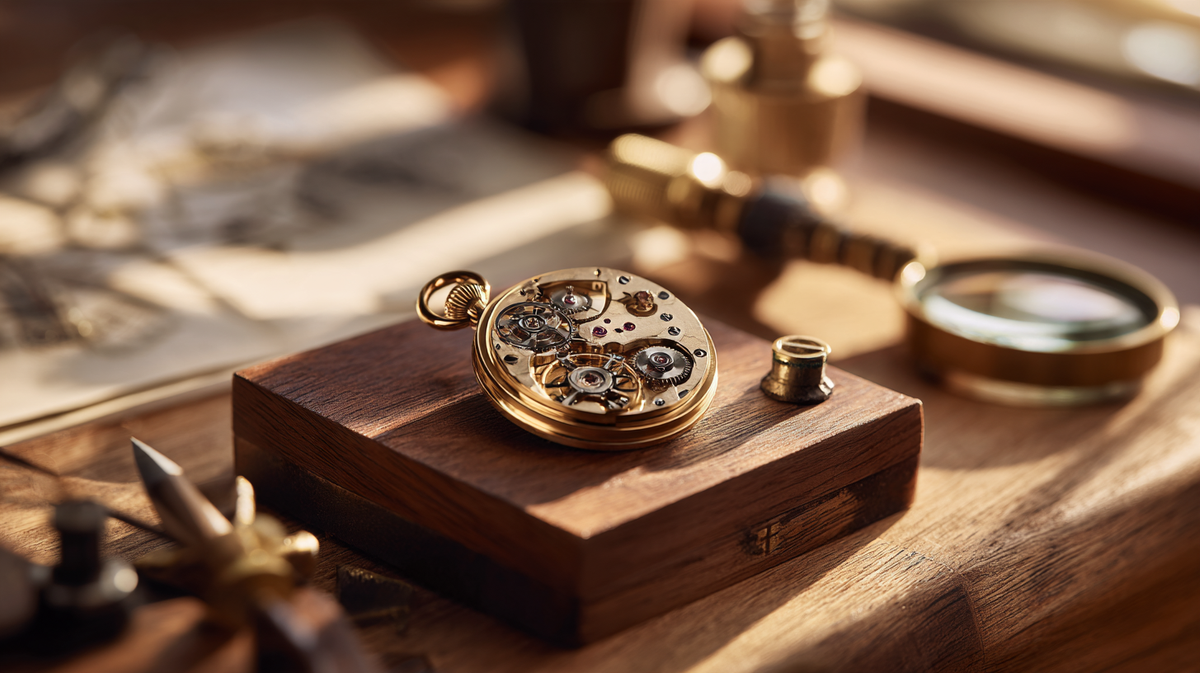
On May 1, 1839, a Polish cavalry officer living in exile named Antoine Norbert de Patek joined forces with a watchmaker named François Czapek to found Patek, Czapek & Cie in Geneva.¹ ² Patek had fled Poland after a failed uprising against Russian rule; Czapek left the partnership six years later over disagreements, and in 1845 Patek met a French watchmaker named Adrien Philippe, the inventor of the keyless winding and setting mechanism that would replace the key-wound pocket watch.² ³ By 1851 the firm carried the name it carries today, Patek Philippe & Cie.² In 1932, in the middle of the Great Depression, two brothers named Charles and Jean Stern, who ran a dial-making business that supplied the company, bought Patek Philippe outright, and it has stayed in Stern family hands for four generations since, the last independent, family-owned watch manufacture left in Geneva.⁴ ⁵ Today it makes roughly 70,000 watches a year, every movement and case built, finished, and assembled in its own workshops.⁶ ⁷

Quick Summary
For more than 120 years, Patek Philippe's guarantee of quality was someone else's stamp: the Geneva Seal, an external certification that mostly judged the finishing on a watch's movement. In 2009 the company walked away from it entirely and wrote its own, stricter standard, the Patek Philippe Seal, with explicit numeric accuracy tolerances and a review that covers the entire watch.⁸ ⁹ Every watch clears that written bar before it leaves the workshop. The specification decides what's good enough, and that's the part almost no company writing an AI job description bothers to build.
A Century of Borrowing Someone Else's Definition of Good
The Geneva Seal, or Poinçon de Genève, dates to a 1886 law passed by the Canton of Geneva to protect the reputation of its watchmaking guild.¹⁰ An independent, state-supervised bureau, today called Timelab, inspects submitted movements against twelve technical criteria covering finishing and materials, and only watches made within the Canton are even eligible.¹⁰ Patek Philippe backed the seal almost from the start and, for more than a century, was one of its most prominent ambassadors; Vacheron Constantin had used it since 1901, and by the time Patek broke away, virtually every prestige movement made in Geneva carried the same hallmark.¹¹ ¹²
That's worth sitting with, because it means Patek Philippe's promise of excellence, for well over a hundred years, was defined by a rulebook the company didn't write and couldn't unilaterally change. The Seal was thorough as far as it went, but it went mainly to the movement's finishing (the polishing and chamfering of screws and plates), and every brand that submitted work to it was measured against the same fixed bar, regardless of how much further any one of them was capable of going.¹³ It's a perfectly reasonable standard, and by definition it belongs to the industry.
Most companies adopting an AI tool today are in that same position without realizing it. They trust a vendor's general-purpose benchmark, or a chatbot's default settings, as their working definition of "good enough": a rulebook they didn't write, calibrated to nobody's business in particular. It's the Geneva Seal problem: borrowed adequacy, mistaken for a standard.
Numbers Instead of Reputation
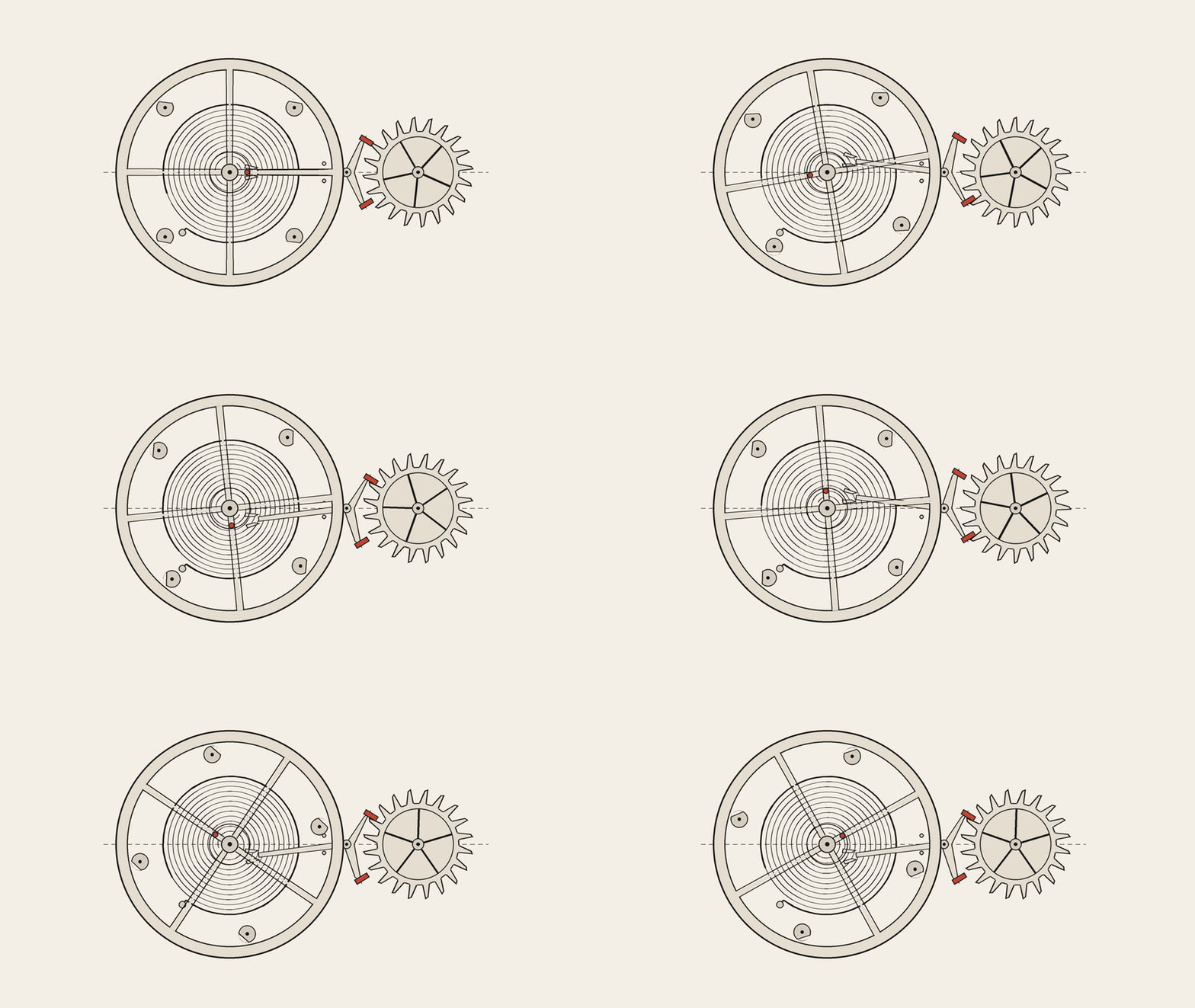
In March 2009, at the Baselworld exhibition, Patek Philippe announced it would stamp its watches with its own mark, the Patek Philippe Seal, and stop submitting its movements to the Geneva Seal.⁸ ⁹ The new mark came with numbers. Movements under 20mm must vary no more than -5/+4 seconds a day; larger movements must hold to -3/+2 seconds a day; tourbillon movements, the hardest to regulate, are held to -1/+2 seconds a day. Since 2024, any watch fitted with the brand's Spiromax silicon balance spring has to meet that same tourbillon-grade tolerance, regardless of complication.¹⁴ Each one is a specification a watch clears or fails, checked against a clock.
That distinction is the whole point. "Accurate" is an opinion until someone attaches a number to it, and a number is the only kind of standard a large organization can enforce consistently, because it doesn't depend on which inspector is having a good day. Patek's break with the Geneva Seal was about refusing to let "good enough" stay undefined.
Takeaway: a standard for AI output that rests on a feeling ("that reads fine," "that seems right") is the Geneva Seal's original problem again: a fixed, borrowed bar with no numbers behind it, applied by whoever happens to be reviewing that day.
Nothing Carries the Seal Until It Passes
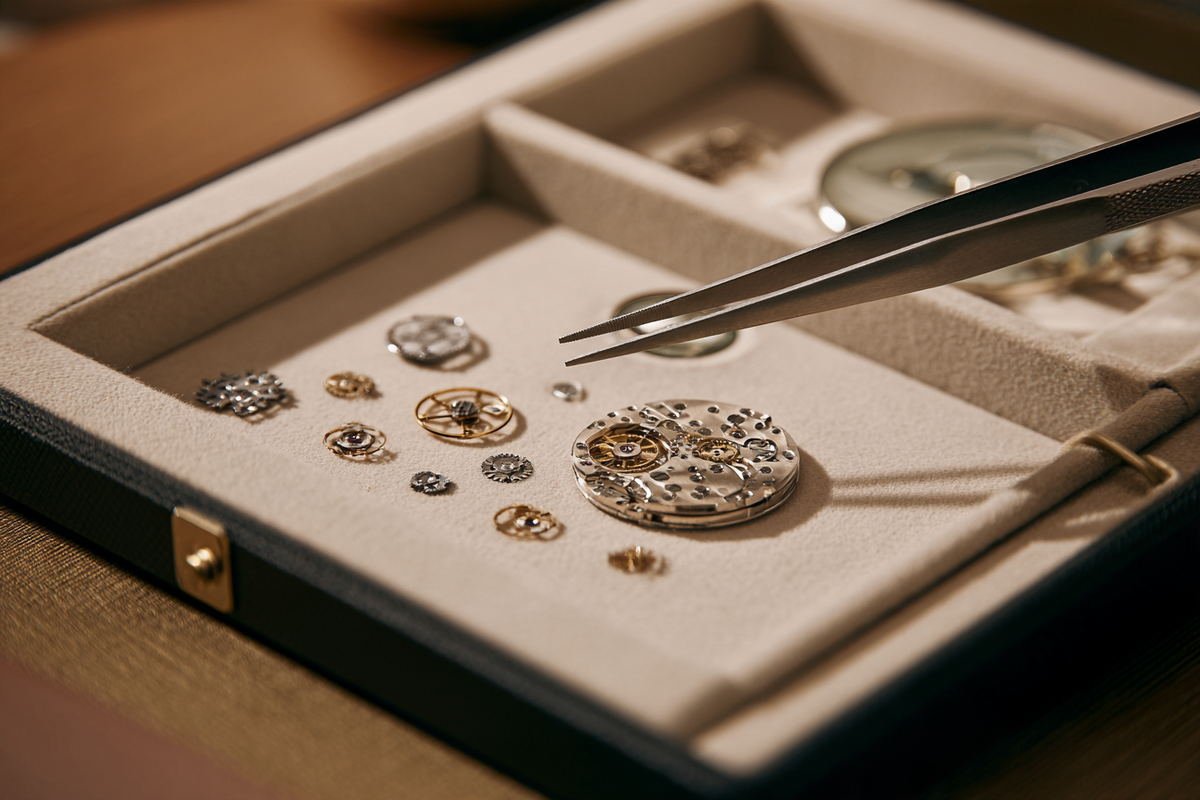
The old Geneva Seal mainly checked the movement. The Patek Philippe Seal checks the entire watch: the movement, the case, the dial, the hands, the bracelet, the clasp, and the watch's actual functions, water resistance, and power reserve once it's fully assembled.¹⁵ By the company's own accounting, producing the components of a single automatic movement requires roughly 1,200 distinct operations, and shaping one wheel or pinion alone can take 40 to 60 of them. An estimated 45 percent of all the labor that goes into a Patek Philippe watch is devoted to meeting the standard the company set for itself.¹⁵ Almost half the work is verification.
That ratio should stop anyone who thinks of quality control as a final step tacked onto the end of a process. At Patek Philippe, checking the work is nearly half the job, built into every stage from the first operation to the last. A watch component advances to the next station once it has been checked against a written criterion and passed.
Picture the alternative: a workshop that skipped that inspection to save time, and shipped a Grand Complication with a flaw no one had checked for. That one story would cost Patek Philippe a reputation built since 1839. The 45 percent is what protects the product.
Takeaway: if your team checks AI work "when there's time," it is treating as overhead the work Patek Philippe budgets at close to half of every watch.
What a Written Standard Automates That Reputation Never Could
| Patek Philippe's discipline | What it forces | 2026 AI-deployment application |
|---|---|---|
| Wrote its own numeric tolerances⁸ ¹⁴ | A specific, checkable pass/fail bar | Define explicit, checkable criteria for what an AI agent's output must meet before your team uses it |
| The Seal evaluates the entire watch, from movement to clasp¹⁵ | Every component is in scope | Review AI output for facts, tone and compliance as well as how it reads |
| ~45% of total labor is devoted to meeting the standard¹⁵ | Verification is budgeted as real work | Assign named reviewer time to checking AI drafts |
| No watch leaves the workshop without the double-P mark¹⁵ | A named, enforced gate before anything ships | Require a named human sign-off before an AI-drafted output reaches a client |
Most companies hear "give the AI a job description" and write a paragraph of intent: be helpful, be on-brand, stick to the facts. Patek Philippe's answer to the same problem was to refuse abstractions entirely: a number, attached to a component, checked by a named process, before anything gets the mark. The job description is the gate a piece of work has to clear before it can be called finished.

Your team's craft deserves the same scaffolding
An AI agent only has a real job description when there's a system to check its work against and a named person who signs off before anything reaches a client. AMW Suite is that system: Sheri drafts inside your CRM and pipeline, every draft routes to your team for approval before it goes out, and the full record (what the agent produced, what a human changed, who approved it) lives in one place. The standard is the approval structure AMW Suite runs on by default. See the Suite →
Why They Walked Away From a Standard Everyone Else Still Trusted

Breaking with the Geneva Seal carried a real risk. Other prestige houses, Vacheron Constantin and Roger Dubuis among them, stayed with it, and an external, state-supervised bureau has one advantage no in-house standard can fully replicate: nobody can accuse it of grading its own homework.¹¹ ¹⁶ Patek Philippe's critics made that point when the new Seal launched: however strict the internal criteria, a company certifying itself is a different claim than an independent body certifying it.¹⁷
Patek answered the objection by making the internal standard stricter and more specific than the external one had ever been, and by publishing the exact numbers, so anyone could check the claim. A borrowed standard is easy to point to and hard to improve. A standard you wrote yourself is harder to defend on day one and the only kind you can tighten every year, because nobody has to vote on it first.
That's the trade a business makes when it stops treating "the AI said so" as sufficient and builds a real approval gate. It's more setup than trusting a chatbot's default behavior. It's also the only version of the process a client can audit, the same way a Patek Philippe owner can check a movement's rate against the number printed on its own certificate.
Takeaway: an external assurance is easy to adopt and impossible to strengthen. A standard your business writes, checks and can point to, the way AMW Suite makes every AI draft traceable to an approval, is harder to build once and stronger every year after.
A Short Test to Run on Your Own AI Deployment
Step 1 — Write your numbers. Patek Philippe didn't say a tourbillon should be "accurate." It said -1/+2 seconds a day.¹⁴ What is the specific, checkable bar an AI draft has to clear before your team treats it as usable?
Step 2 — Check the whole watch. The old Geneva Seal mostly checked finishing on the movement for over a century. Does your review of AI output only check spelling and tone, or does it check facts, compliance, and whether it reflects what the client asked for?
Step 3 — Budget the 45 percent. If verification is worth nearly half of Patek's total labor, what share of your team's time is assigned to reviewing AI output, and how much are you assuming happens for free?
Step 4 — Name who holds the stamp. Every Patek Philippe watch has a specific, named process it must clear before the double-P mark goes on. Does anything your AI produces have a named person whose job is to check it before it reaches a client, or does it go straight out?
Patek Philippe became the standard everyone else copies by defining, in writing and in numbers, what its own excellence meant, and letting nothing carry its name until it cleared that bar. That's the model for a job description, whether it's stamped into a movement or built into the approval flow an AI agent runs inside every day.
Sources
-
1
Patek Philippe, founded 1839, Antoine Norbert de Patek’s exile and founding of Patek, Czapek & Cie
-
2
Patek Philippe, founding timeline, name changes 1839–1901
-
3
The 1916 Company, “The History of Patek Philippe: Legacy of Swiss Watchmaking” (Adrien Philippe and the keyless winding mechanism)
-
4
Patek Philippe
-
5
The last independent, family-owned Genevan manufacture
-
6
Patek Philippe, 2023 production output, ~70,000 watches
-
7
The last independent, family-owned Genevan manufacture, vertically integrated production
-
8
Patek Philippe’s New Quality Mark, May–Jun 2009 issue; the 2009 break from the Geneva Seal
-
9
How to Identify a Fake Geneva Seal Watch
-
10
The Geneva Seal: A Symbol of Quality or Origins
-
11
Patek Philippe’s New Quality Mark, Vacheron Constantin’s use of the Geneva Seal since 1901; Patek’s long affiliation
-
12
The Geneva Seal, Roger Dubuis and other brands built around the Seal
-
13
Fascinating..., Geneva Seal’s limited scope — finishing and workmanship of the movement
-
14
Different Watch Certificates, Patek Philippe Seal numeric tolerances, 2009 and 2024 updates
-
15
Patek Philippe: The Elegance of Time, Seal covers entire watch; ~1,200 operations; 45% of labor devoted to quality standards
-
16
The Geneva Seal, other brands still using the Geneva Seal
-
17
PP seal, contemporary criticism that an in-house seal cannot be fully independent

Valencia Jackson is a Communications Director at AMW, where she develops creative strategy and brand positioning for clients ranging from emerging brands to Fortune 500 companies.
Related Resources
Related Articles
The Story of Polaroid: Edwin Land and the Instant Photo
A child's question in Santa Fe in 1943 became the SX-70, the Giant Polaroid and one of America's most admired brands. Then came Kodak, the phone and a factory set for demolition.

Nano Banana 2.1 Review: Spelling Right, Details Slip
We gave Google's Nano Banana 2.1 a bakery chalkboard sign and a candle product shot. It spelled every price correctly, then slipped on smaller details worth checking.
How Colonel Sanders Franchised a Recipe Before Fast Food
In 1952 Harland Sanders licensed his fried chicken to a Utah restaurant for four cents a bird. Here's how the deal worked and what service firms packaging their know-how can learn from it.