

Selling the Fresh Start: What a Century of New Year's Resolutions Teaches Marketers in 2026

In 1961, a housewife in Queens named Jean Nidetch had a secret. She was following the diet a New York City obesity clinic had given her, and at night, with her family none the wiser, she would lock herself in the bathroom and eat cookies she had hidden in the clothes hamper1. Earlier that year a woman in the supermarket had asked her when the baby was due. She was not pregnant. She was 5 feet 7 and weighed 214 pounds1.

Quick Summary
A new year makes people want to change, and the effect is measurable: U.S. Google searches for "diet" run 82.1% above baseline at the start of a year4. Businesses have built their calendars around it. Weight Watchers did its heaviest recruiting and advertising in the first quarter2, and Planet Fitness, whose member joins peak in January, has spent a decade as the presenting sponsor of New Year's Eve in Times Square6. The energy fades. Resolutions were a joke in American print by 18953, most interventions to keep people exercising stop working when they end10, and Weight Watchers itself filed for bankruptcy in May 20255. The research also shows what lasts: a named supporter11, goals framed as something to do11, a plan for the missed day10, and fresh starts that arrive all year, from Mondays4 to birthdays12.
She had to tell someone, so she invited six overweight friends to her living room, where they confessed what they had eaten and talked each other through the hunger. Friends brought friends. Within two months, 40 women were crowding into her home every week to hold one another to account1. In 1963 she, her husband and two members of her group, Felice and Albert Lippert, founded Weight Watchers1. The company came to do its most important business at the start of every year, in the quarter it calls its "winter or peak season"2.
This is the story of that season. It covers why a date on the calendar makes people want to be better, how companies from Weight Watchers to Planet Fitness learned to meet them there, what the research says about why most of that energy is gone by spring, and what a marketer planning for 2026 can take from all of it.
Some people who ought to swear off
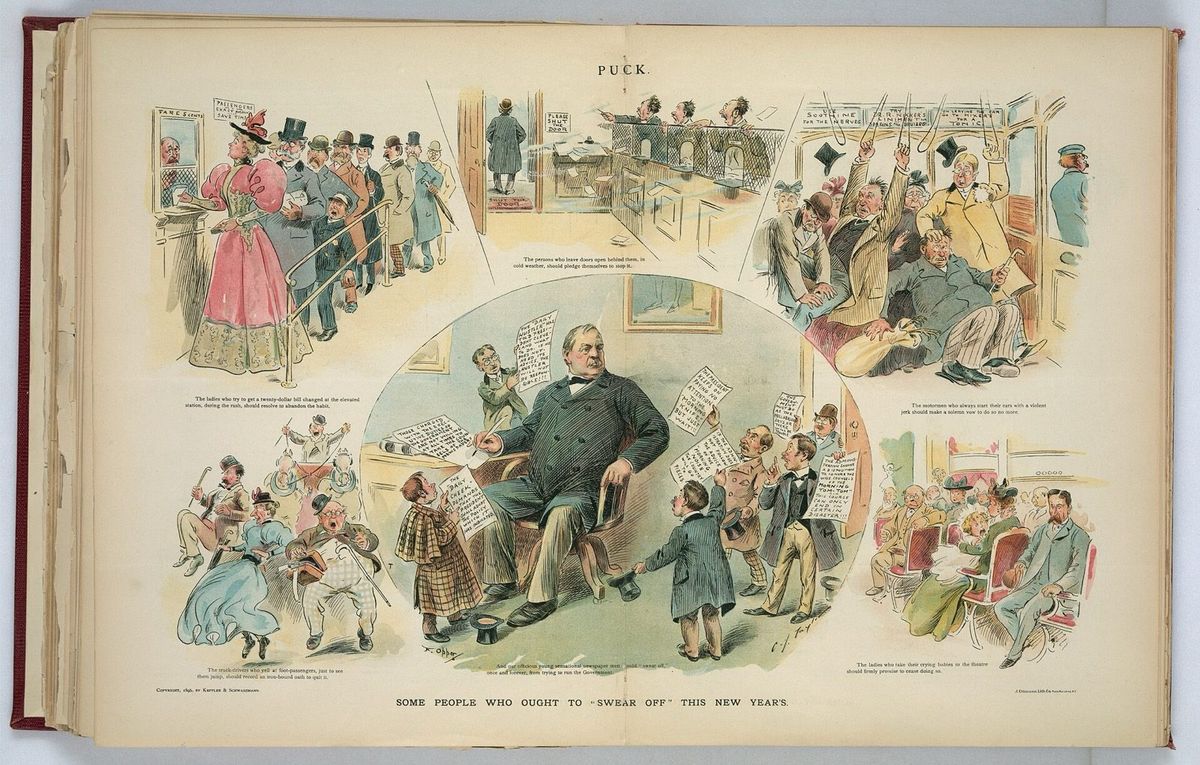
The New Year's resolution was already a running joke in the 1890s. On January 2, 1895, the humor magazine Puck ran a centerfold by Frederick Burr Opper titled "Some people who ought to 'swear off' this new year's"3. At its center sits President Grover Cleveland, hounded by newspaper reporters waving advice, and Puck suggests that the press resolve to leave the running of the government to the people elected to do it3.
Around the edges, Opper drew the smaller sins that annoyed his readers: people who bring crying infants to the theatre, people who try to change a large bill at a train station at rush hour, people who leave a door open behind them in cold weather3. The cartoon assumes something its readers took for granted: on the first days of January, people made promises about their behavior. The joke works only if readers expected plenty of those promises to fail.
That assumption is the raw material of an industry. Many resolutions end in a purchase: a diet program for someone who resolves to lose weight, a gym membership for someone who resolves to get fit, a savings plan for someone who resolves to save. The businesses that sell those things get a wave of customers who arrive already persuaded. A team at the Wharton School later measured how big that wave is.
Eighty-two percent
In 2014, three researchers at the Wharton School, Hengchen Dai, Katherine Milkman and Jason Riis, published a paper in Management Science that put numbers on the feeling4. They started from a simple observation: "The popularity of New Year's resolutions suggests that people are more likely to tackle their goals immediately following salient temporal landmarks"4. If that was true, it should show up in what people actually do.
They tested it three ways. First, they downloaded daily U.S. Google search volume for the word "diet" from January 1, 2004, to June 30, 2012, a stretch of 3,104 days4. Second, they used attendance records from a university gym. Third, they looked at 66,062 commitment contracts that users had written on stickK, a website where people set a goal and name a penalty for missing it4.
The pattern was the same in all three. Relative to baseline, interest in dieting rose at the start of a new week by 14.4%, at the start of a new month by 3.7%, after federal holidays by 10.2%, and at the start of a new year by 82.1%4. On stickK, people were 145.3% more likely to commit to a goal at the start of a year4.
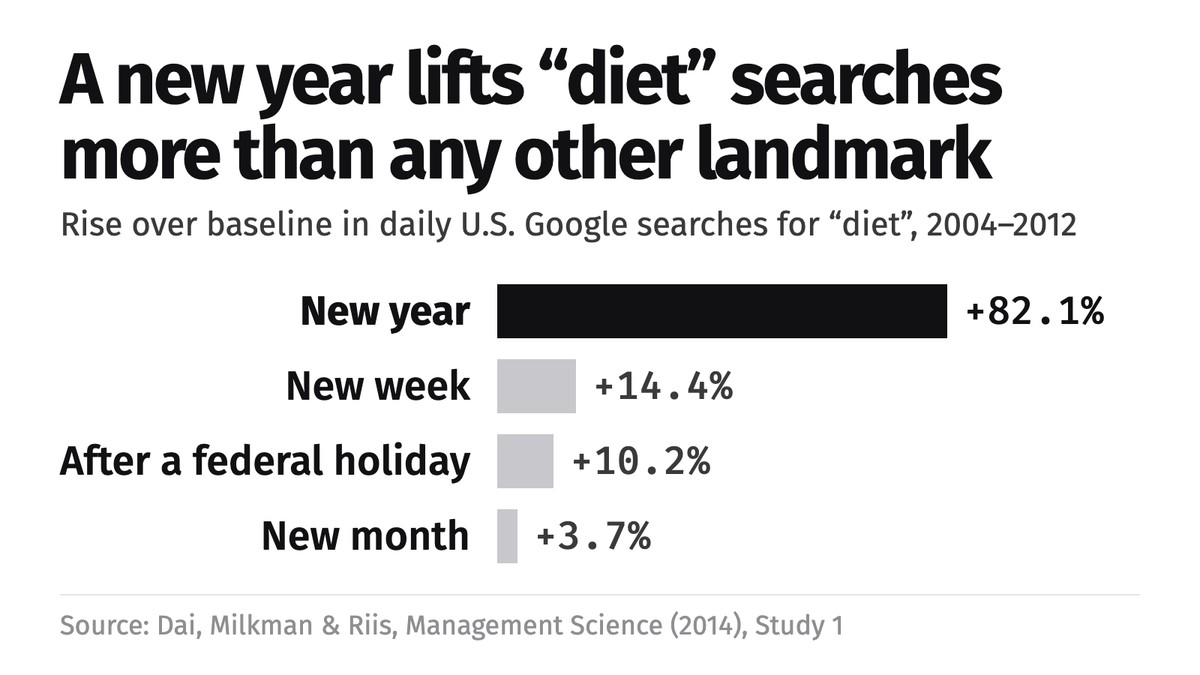
The authors named it "the fresh start effect." Their explanation is that dates like these "demarcate the passage of time, creating many new mental accounting periods each year, which relegate past imperfections to a previous period, induce people to take a big-picture view of their lives, and thus motivate aspirational behaviors"4. In plain terms: January lets people file last year's failures under last year.
The gym data added a detail that matters for anyone who sells. At the university gym, the probability of a visit rose by 11.6% at the start of a new year, but by 33.4% at the start of a new week and by 47.1% at the start of a new semester4. For students, the semester was a bigger fresh start than January. The strongest landmark depends on whose calendar it is.
The highest concentration of advertising
Companies describe the same wave in their annual reports to the Securities and Exchange Commission, where they explain to investors what drives their results.
WW International, the company Weight Watchers became, put it plainly in its report for fiscal 2024: "Historically, we experience our highest level of recruitment during the first quarter of the year, which is supported with the highest concentration of advertising spending"2. It called the first quarter "our winter or peak season" and warned investors that if its advertising failed to bring in enough recruits in that quarter, "it historically has had an outsized negative impact on our performance for the remainder of the year"2. The year was decided in a single quarter.

Nidetch had built the business that made that sentence possible. Weight Watchers went public in 1968, and when it turned ten in 1973, 16,000 people came to a party at Madison Square Garden with Bob Hope on stage1. In 1978 she and her partners sold it to H.J. Heinz for about $71 million1. The meetings stayed at the center of the business. By 2015 the company held more than 36,000 weekly meetings modeled on the ones she started1. "Compulsive eating is an emotional problem," she told Time magazine in 1972, "and we use an emotional approach to its solution"5.
Planet Fitness describes the same season in almost the same words. Its annual report for 2024 says "member joins are typically higher in January as compared to other months of the year"6. The company ended that year with approximately 19.7 million members and 2,722 clubs6. It has also bought the moment the year begins. "For the past 10 years, we have sponsored 'Dick Clark's New Year's Rockin' Eve with Ryan Seacrest,'" the report says, "and have been the sole presenting sponsor of the Times Square New Year's Eve celebration"6.
The sponsorship, the report says, allows "the brand to be featured prominently in TV broadcasts covering Times Square during the celebration"6. It is the fresh start effect turned into a media plan: when the ball drops and viewers file last year away, the gym brand is on the screen.
Those New Year resolutions
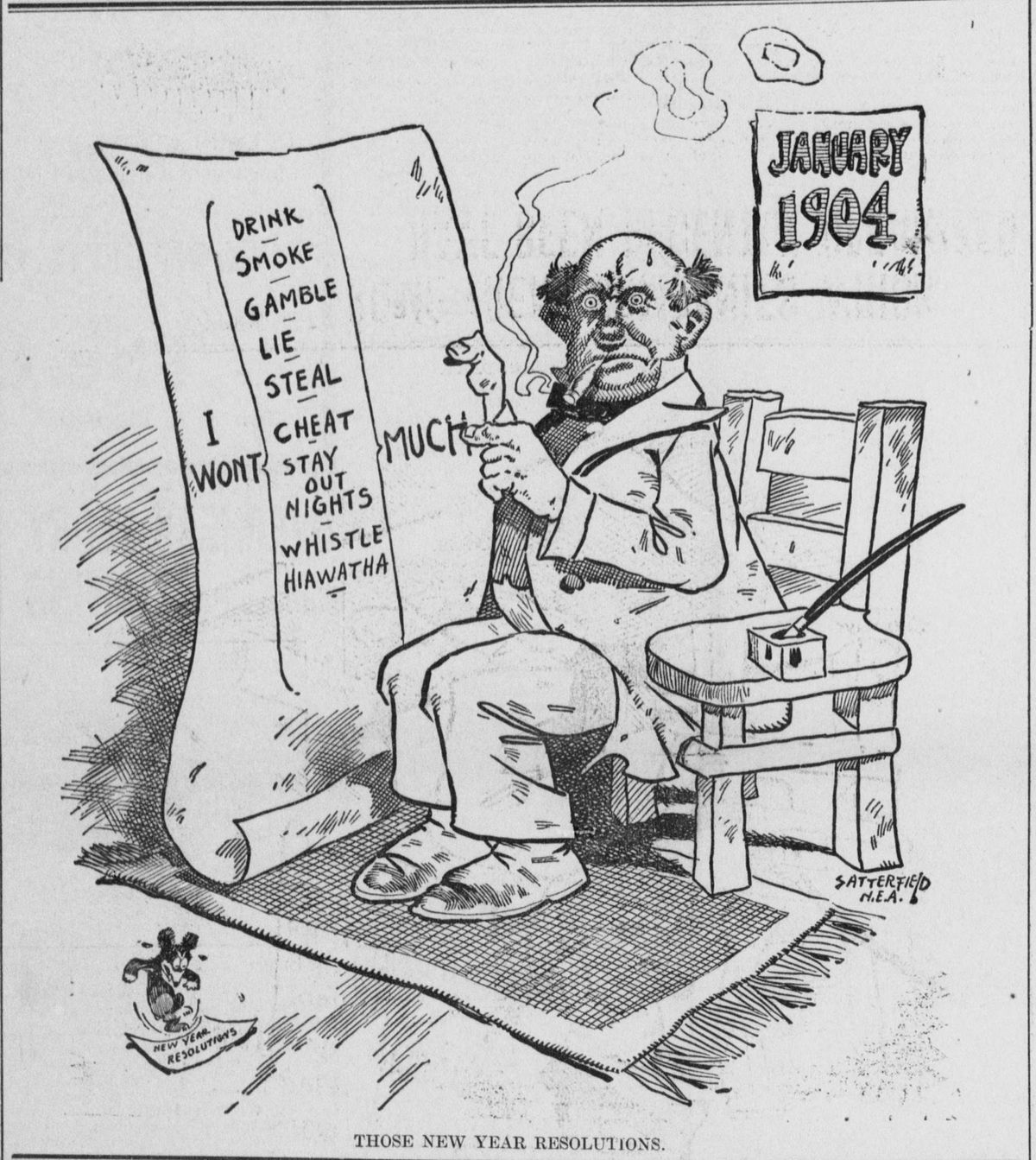
The trouble with January customers is that many of them stop. Newspapers knew this too. On January 5, 1904, the Tacoma Times ran a cartoon by Bob Satterfield called "Those New Year Resolutions"7. A bald man with a cigar sits under a calendar reading January 1904, holding a scroll that reads "I won't" above a list: drink, smoke, gamble, lie, steal, cheat, stay out nights, whistle Hiawatha. Next to the list, in larger letters, he has added the word "much." Five days into the year, he has already rewritten the promise to fit the behavior.
A century later, psychologists put a number on how many resolutions survive. In a study published in 2002, John Norcross and colleagues followed 159 New Year's resolvers and 123 people who wanted to change similar problems later but had not made a resolution, phoning them for six months8. The most common goals were losing weight, starting an exercise program and quitting smoking. At six months, 46% of the resolvers were still succeeding, compared with 4% of the non-resolvers8.
That result cuts both ways, and both matter to a marketer. Making a resolution works: resolvers were more than ten times as likely to succeed as people who meant to change "later." And at six months, more than half of the resolvers were no longer succeeding. A business that fills up in January is serving people who are unusually likely to change and who will, in large numbers, leave anyway. The WW report shows the shape of it in its own subscriber count, which was typically highest in the first quarter, "historically reflecting a decline over the course of the year"2.
A penny stock
That decline was part of the Weight Watchers year. What changed was what its customers could buy instead. On May 6, 2025, WeightWatchers filed for Chapter 11 bankruptcy5. CNN reported that the company had struggled with about $1.5 billion in debt and "failed to keep pace with more convenient weight loss options, including GLP-1 drugs like Ozempic, over counting points and calories"5.
The company had tried to follow its customers. A former chief executive bought a telehealth platform that connected patients with doctors who could prescribe weight-loss drugs, but the pivot did not work, and she was forced out in September 20245. Its earnings release in February 2025 showed a 12% decline in members5. Oprah Winfrey, who had credited the program with helping her lose 40 pounds and later revealed she had also used a weight-loss drug, left its board in 2024 after nearly a decade5. The company still had 3.3 million subscribers at the end of 2024, and its shares, which had traded at around $100 at their 2018 peak, had become a penny stock5.
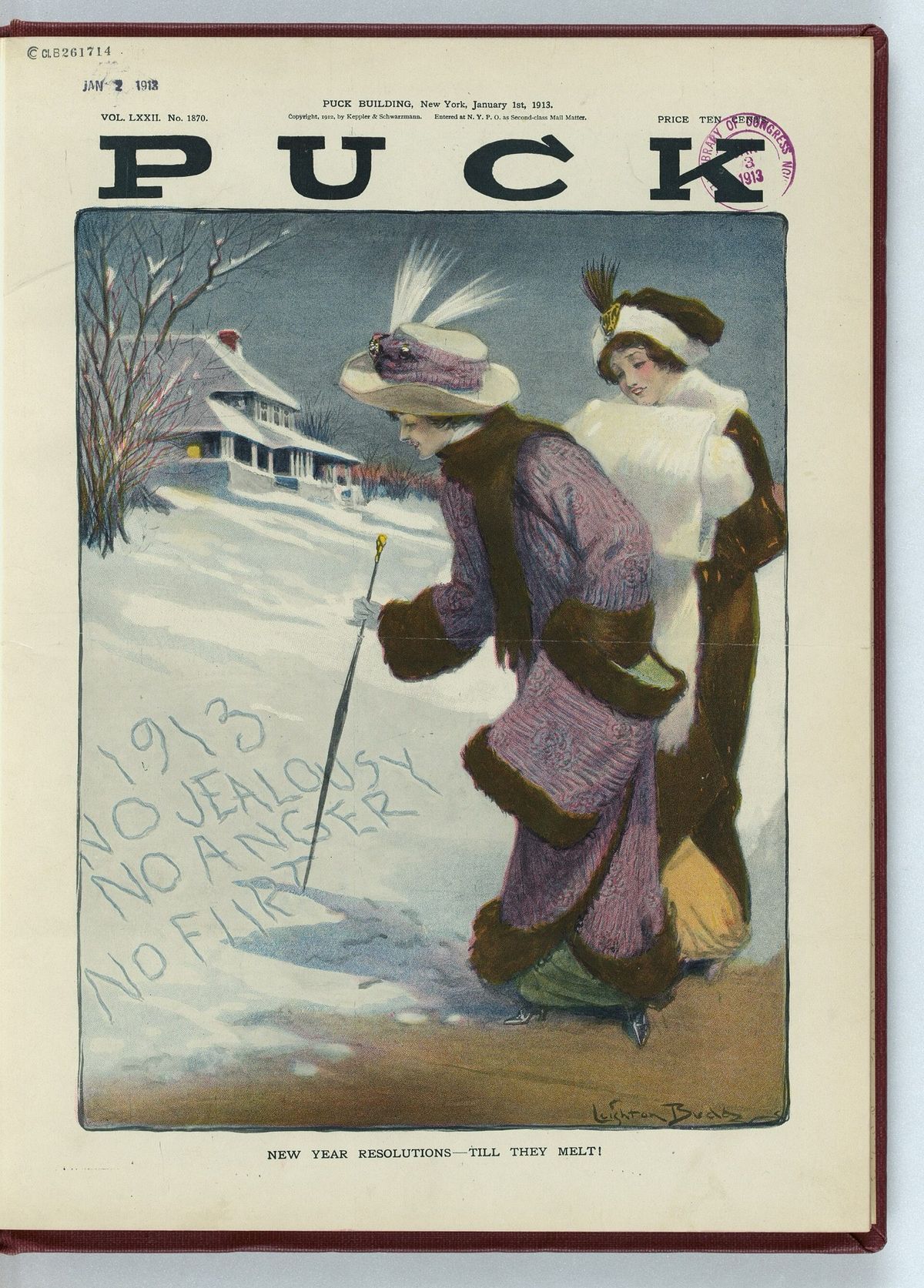
The honest lesson is uncomfortable for anyone who sells into January. A reliable season can hide a weakening product. People still wanted to lose weight at the start of each year. New drugs gave them a more convenient way to try, and the company that had built its year around their resolutions could not keep pace5. Puck had a line for this kind of intention on its cover of January 1, 1913, where a young woman in furs writes her resolutions into the snow with the tip of her umbrella: "1913 No Jealousy No Anger No Flirt." The caption gives them until the thaw: they will last "till they melt!"9. Demand that arrives with the calendar can leave with the weather.
Microrewards for coming back
If most resolutions fade, the useful question for a business is which help actually keeps people going. In 2021, Katherine Milkman and 29 other scientists from 15 U.S. universities published the answer to one version of that question in Nature10. Working with 61,293 members of an American fitness chain, 24 Hour Fitness, they tested 54 different four-week digital programs designed to get people to the gym, all in the same population, on the same measure, over the same period10.
The results were humbling. In all, 45% of the programs increased weekly gym visits during the four weeks, by 9% to 27%10. But only 8% produced a change that was still significant and measurable after the program ended10. The authors also asked impartial judges to forecast which ideas would work best, and the forecasts "failed to predict which interventions would be most effective"10. The experts could not tell in advance.
The winner was specific: "the top-performing intervention offered microrewards for returning to the gym after a missed workout"10. The program that worked best planned for the lapse. It assumed people would miss a day, as the Tacoma man with the scroll did, and it paid them to come back. By this result, the valuable moment is the first visit after a miss, and a campaign built only for the first visit never reaches it.
One person responsible
A Swedish study of more than a thousand people tested a different kind of help: support from another person. In late December 2016, researchers at Stockholm University recruited 1,066 members of the public and randomly split them into three groups: no support, some support, and extended support11. At the one-year follow-up, 55% of those who responded considered themselves successful11.
The group that did best was the middle one. People given "some support" were asked to name "a specific person responsible for supporting them throughout the year," were checked on monthly and received one email on coping with hurdles11. They reported a success rate of 62.3%, against 55.9% for the group with no support and 52.5% for the group with extended support, which added instructions on goal-setting and interim goals11. More help did worse than the right help.
The same study found that how a goal is phrased matters. Participants whose resolution was to approach something were more successful than those whose resolution was to avoid something: 58.9% against 47.1%11. The Tacoma man's scroll, a list of things he won't do, was the weaker kind of resolution.
Every Monday is a small January
The most useful finding for a marketer may be the one that sounds least like January at all. The Wharton paper found fresh starts at the start of every week and month, after holidays, and after birthdays4. A later field experiment by John Beshears, Hengchen Dai, Katherine Milkman and Shlomo Benartzi, published in 2021, tested whether a business could use that deliberately12.
They mailed 6,082 university employees an offer to increase their retirement savings either now or at a future date12. For some employees the future date was just a delay, such as "in 2 months." For others the same date was framed as a fresh start, "after your next birthday," or at New Year's, or on the first day of spring12. The framing increased the likelihood of choosing to save later without reducing the number who chose to save immediately, and it increased cumulative contributions over the next eight months by roughly 25% more than the other mailings12. Placebo dates that do not feel like new beginnings (Thanksgiving, Martin Luther King Day and Valentine's Day) had no positive effect12.
That is a precise instruction. A fresh start is a frame a business can offer on any customer's calendar, on dates that mean a new beginning to that customer, in any month of the year.
The lessons for marketers in 2026
January brings demand, and the product has to keep it. Weight Watchers told investors its recruitment peaks in the first quarter2, and Planet Fitness said the same of January6. Weight Watchers also showed that a reliable season can mask a product customers are ready to replace5. Read your January numbers as a test of the offer as well as the campaign.
Plan the second visit before the first. The best of 54 gym programs rewarded people for coming back after a missed workout, and only 8% of programs had effects that outlasted them10. A welcome sequence that stops in week two is built for the part of the year that takes care of itself.
Name the person. Nidetch's living room1 and the Stockholm group that named a supporter11 point the same way: accountability to a specific person helps a change hold. For a service business, that can be as simple as a named contact who checks in when a customer goes quiet.
Frame goals as something to do. Approach goals beat avoidance goals in the Stockholm study11. Copy that promises what a customer will start doing tends to match the kind of resolution that lasts.
Use the other fresh starts. Mondays, new months, semesters and birthdays all lift aspirational behavior4, and a birthday framing raised savings in a real field test12. The dates that work are the ones that feel like a beginning to the customer, which is why the placebo holidays had no positive effect12. A customer database that holds sign-up dates and birthdays holds a calendar of fresh starts.
Test, because the experts cannot call it. Impartial judges could not predict which of the 54 exercise programs would work10. The same humility applies to any January campaign built on a hunch.
Jean Nidetch lived to 91. In 2011, when she was 87, she told a reporter she still weighed 142 pounds, her goal weight from decades before, and that her advice to dieters had not changed: "Drop the damn fork!"1. The company she founded filed for bankruptcy a decade after her death. The thing she built in her living room, a room full of people who had each promised to change and were counting on each other to keep the promise, is still the part of the fresh start the research says lasts.
Sources
- 1
- 2
- 3
- 4
- 5
- 6
- 7
- 8
- 9
- 10
- 11
- 12

The AMW® Editorial Team covers marketing, business growth and the software AMW builds for businesses.
Frequently Asked Questions
What is the fresh start effect?
It is the finding, published by Wharton researchers Hengchen Dai, Katherine Milkman and Jason Riis in Management Science in 2014, that people are more likely to pursue goals right after temporal landmarks such as a new year, a new week, a new month, a holiday or a birthday. In their data, U.S. Google searches for "diet" rose 82.1% above baseline at the start of a new year.
Why do businesses such as gyms and diet programs focus on January?
Because that is when customers arrive. Planet Fitness reports that member joins are typically higher in January than in other months, and WW International (Weight Watchers) reported its highest recruitment in the first quarter, supported by its highest concentration of advertising spending.
How many New Year's resolutions succeed?
In a 2002 study by John Norcross and colleagues, 46% of New Year's resolvers were still succeeding at six months, compared with 4% of people who wanted to change but had not made a resolution. In a 2020 Stockholm University study of 1,066 people, 55% of those who responded considered themselves successful after one year.
What helps a resolution last?
In the Stockholm study, people who named a specific person to support them and received monthly check-ins did best, and goals framed as approaching something beat goals framed as avoiding something (58.9% against 47.1%). In a Nature megastudy of 61,293 gym members, the most effective program rewarded people for returning after a missed workout.
Can marketers use fresh starts outside January?
Yes. The original research found fresh start effects at the start of weeks, months and semesters and after birthdays. In a 2021 field experiment with 6,082 university employees, framing a savings increase as starting "after your next birthday" or at another fresh start date raised contributions, while dates such as Thanksgiving and Valentine's Day had no positive effect.
Related Resources
Calculators
Case Studies
Related Services
Pricing Guides
Related Articles

TechCrunch Disrupt 2026: A Plan If You're Not Raising
Going to TechCrunch Disrupt 2026 without a pitch deck? Use this working plan to turn one week in San Francisco into customers, partners, hires and market intel.

How a Failed Snowboard Shop Led to Shopify
Shopify began as the software behind Snowdevil, an Ottawa snowboard shop that didn't last. What happened, why the software outgrew the store, and what operators can take from it.

What to Automate First When AI Agents Join Your Team
AI agents are arriving inside everyday business software. Here's the order that tends to work: reading first, approved drafts second, judgment calls kept with people.