

Inside the Oreo Marketing Strategy That Keeps the Brand Relevant Across Generations

On February 3, 2013, the lights went out in the Mercedes-Benz Superdome in New Orleans during Super Bowl XLVII. Lisa Mann, then vice president of cookies at Kraft, was watching at home. She had turned down invitations to the game because she wanted to watch it on her couch, as a consumer1.

Quick Summary
Oreo was launched by Nabisco in 1912 and is now the largest brand of Mondelez International, which said it passed $3.1 billion in annual net revenue in 2019. Its marketing rests on a few steady habits: it advertises the twist, lick and dunk ritual, it keeps the original cookie largely unchanged while releasing a stream of limited editions, sizes and collaborations around it, and it speaks mainly to adults, since Mondelez does not advertise in media aimed at children under 13. Abroad it has adapted flavors, pack sizes and prices market by market, from two-yuan packs in China to five-rupee packs in India. Its best-known campaigns include the 100-day Daily Twist in 2012, the Dunk in the Dark tweet during the 2013 Super Bowl blackout, Wonderfilled, the 2020 Oreo vault in Svalbard and celebrity cookies with Lady Gaga, Post Malone and Selena Gomez. The brand has also faced criticism, from Hydrox's claim to be the original to the 2021 Nabisco strike.
In the war room Oreo and its digital agency, 360i, had set up for the game, ten people were watching too. Creative director Michael Nuzzo was holding a pulled pork slider when the power failed. "I spun around and looked at the guys and said, 'We should probably do something,'" he later told Digiday. "We had the post together in under a minute." The associate brand manager in the room emailed Mann with the line she wanted to use. Mann read it aloud to her daughters. "So I said, 'Yes, send,'" she recalled1.
The tweet read "Power out? No problem." Its image carried the line "You can still dunk in the dark." Play stayed suspended for 34 minutes, and the next morning HuffPost called the tweet one of the most buzz-worthy ads of the Super Bowl2.
Mann has a line about that evening that explains most of what follows. "I always say, that it took two years to do that tweet. Everyone thinks it just happened," she said1. Oreo's marketing looks spontaneous, and it rests on long-standing habits: a ritual Nabisco was advertising by the 1920s, an original cookie kept largely the same while new versions multiply around it, a steady focus on adults who remember being children, and a willingness to rebuild the product for each new country. This article sets out what the record shows about Oreo's brand, its target market, its marketing mix, its campaigns and expansion, how its results have been measured, and the places where the strategy has run into trouble.
Oreo's Brand Identity and Positioning Strategy
The Evolution of Oreo's Core Brand Elements
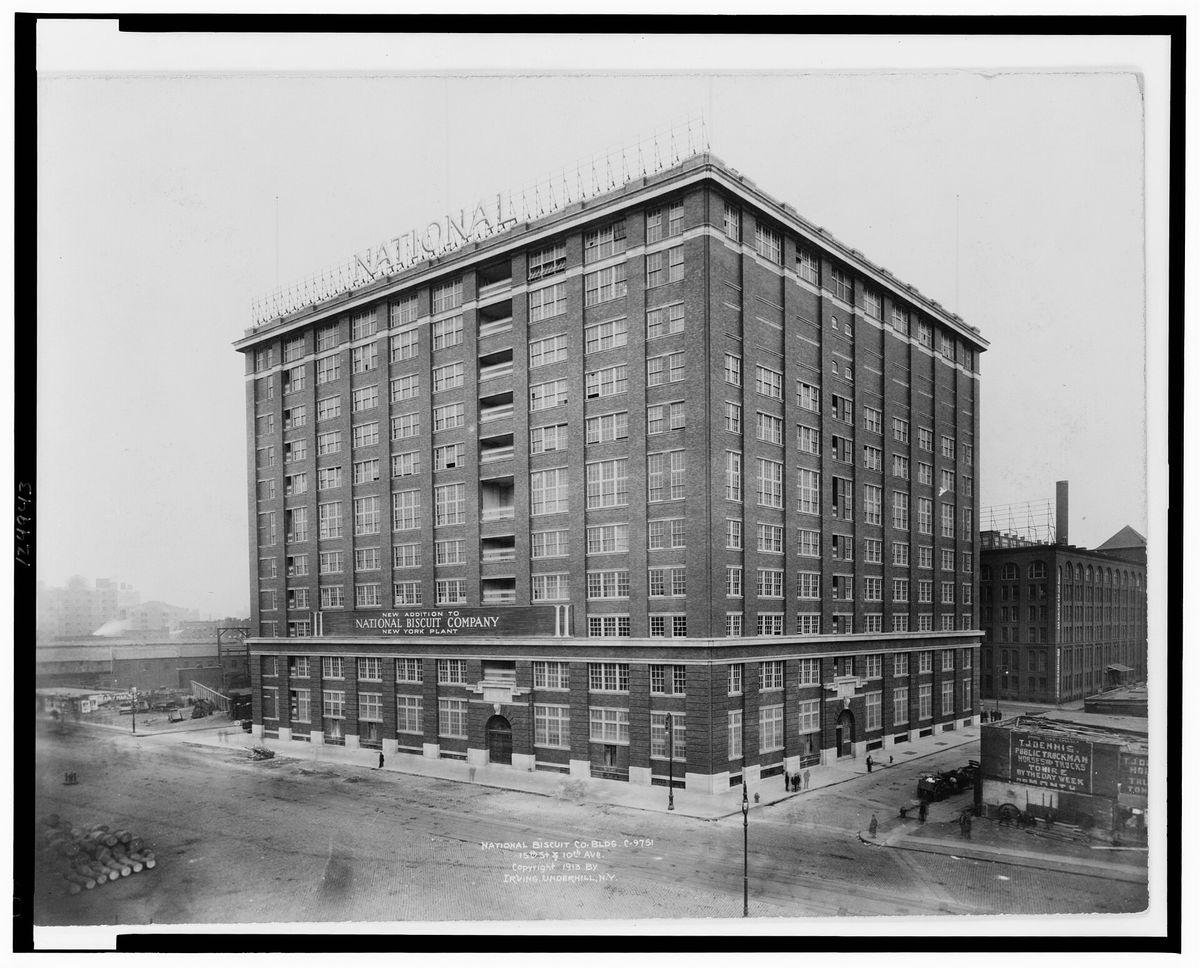
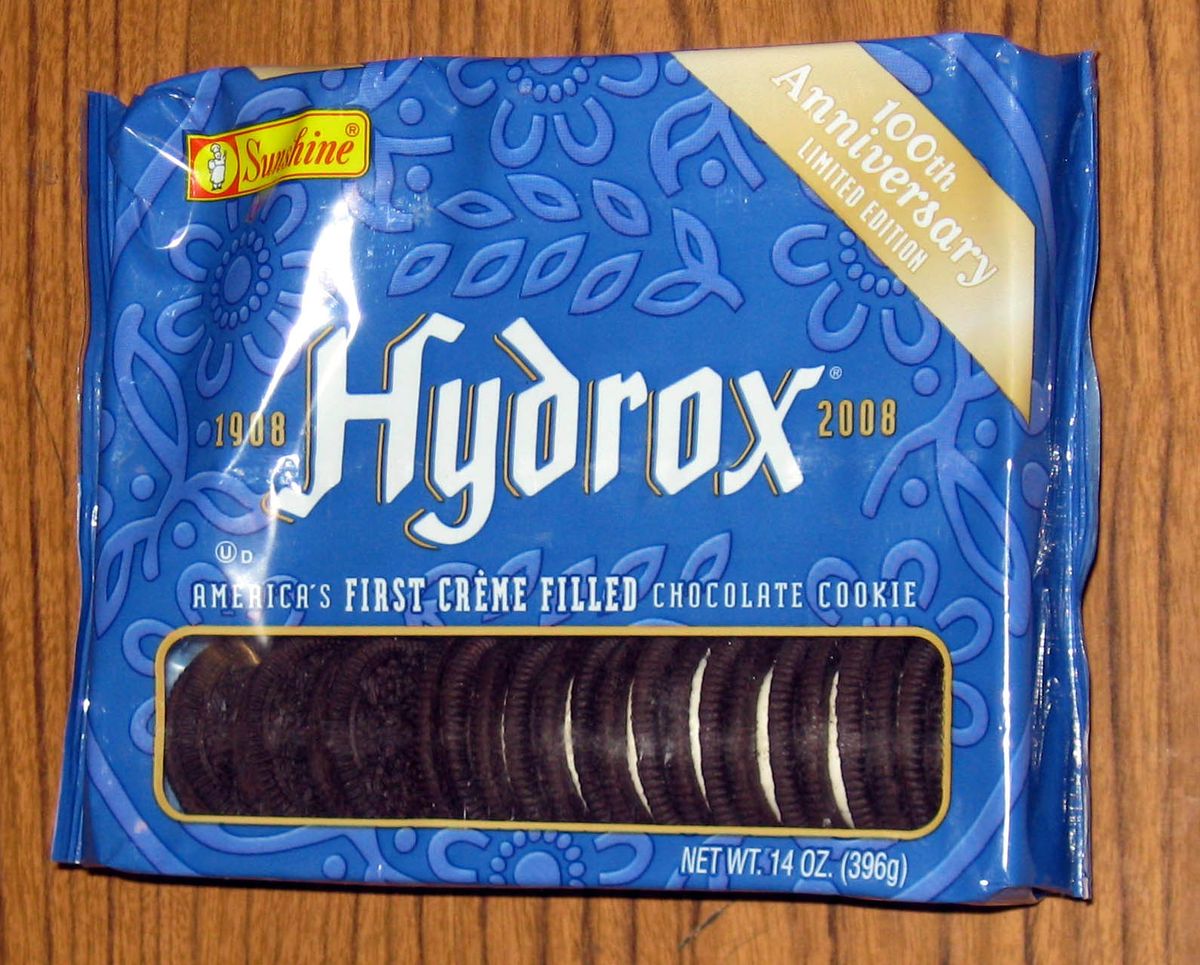
Oreo began as a response to a rival. In 1908 the Loose-Wiles Biscuit Company of Kansas City put two dark chocolate wafers around a layer of vanilla creme and called it Hydrox, which KCUR describes as America's first chocolate sandwich cookie. In 1912 the National Biscuit Company, better known as Nabisco, answered with the Oreo Biscuit, advertised as "two beautifully embossed chocolate flavored wafers with a rich cream filling"3. "Not only was Oreo this copycat of Hydrox, it was also built on the back of the company that Jacob had founded himself," pastry chef and author Stella Parks told KCUR, referring to Loose-Wiles founder Jacob Loose, who had helped build the company that became Nabisco3.
Kraft Foods' fact sheet for the 100th birthday sets out the early milestones. The first Oreo came off the line at Nabisco's Chelsea bakery in Manhattan, the first sale was in Hoboken, New Jersey, and the cookies were packed in bulk tins and sold by weight, with grocers paying 30 cents a pound. The Oreo was registered as a Nabisco trademark in 1913, renamed the Oreo Sandwich in 1921 and the Oreo Creme Sandwich in 1937. In 1923 the first advertisement showing the "twist" appeared on trolley cars, and the cookies became available in a self-service fiberboard package4. TIME noted in 2012 that two versions debuted in 1912, original and lemon meringue, and that Nabisco dropped lemon meringue in the 1920s5.
The name itself has no confirmed origin. TIME reported that some believe it came from "or," the French word for gold, because the early packaging was mostly gold, and others from the Greek word for mountain, perhaps because a test version was hill-shaped5. In 2025 the brand turned that uncertainty into a campaign, as later sections describe.
The face of the cookie changed twice before it settled. The original design was sparse, a ring of laurels and turtledoves was added in 1924, and the pattern still used today arrived in 19526. A Nabisco blueprint from July 17, 1952 names William A. Turnier, a member of Nabisco's engineering department, as the man who drew it, though the Kraft Foods archivist INDY Week contacted in 2011 would not confirm who came up with the design6. Kraft's own timeline describes the 1952 change as adding the Nabisco colophon emblem to the cookie4.
The filling has changed more than the look. Sam Porcello, the Nabisco food scientist known as "Mr. Oreo," developed a new filling and the chocolate-covered and white chocolate-covered Oreos, and held five patents relating to Oreos, the New York Daily News reported at his death in 20127. Oreos were long made with lard. Once Nabisco removed it, the company spent more than three years converting its ovens to make the cookie kosher, a conversion completed in December 1997 according to the Orthodox Union. "It was probably the most expensive conversion of a company from non-kosher to kosher," Cornell food scientist Joe Regenstein said in 20088.
Packaging followed the market. Kraft's timeline records a one-pound cardboard carton with three waxed-paper "stack packs" in 1965, a complete line of single-serve items in the U.S. in 1983, on-the-go Mini packs in 2000 and Snack 'n Seal packaging in 20074.
Brand Personality and Consumer Connection
For most of its life Oreo has sold a feeling about childhood to the people who have outgrown it. Kraft's list of Oreo slogans runs from "Oh!, Oh! Oreo!" in 1950 through "For the Kid in All of Us" in 1980, "Who's The Kid with the Oreo Cookie?" in 1986 and "Oreo, The Original Twister" in 1990 to "Milk's Favorite Cookie" in 20044.
The ritual is the connection. Kraft's 2012 fact sheet reported that 50 percent of Oreo eaters pull their cookies apart before eating, with women twisting them open more often than men4. In Canada, where the brand ran slogans such as "Twist to open" and "Some disassembly required," brand manager Kristi Murl told Strategy in 2008: "Oreo is the brand that lets people connect in simple ways, and over the years a lot of the marketing initiatives have supported that."9
Even new products were introduced through the ritual and its memories. For the Canadian launch of Golden Oreo in 2005, agency Draftfcb ran print ads with the tagline "Surprise Your Milk" and a TV spot in which one child tells another, "When I was your age, Oreos were chocolate."9 The Canadian team marked Oreo's 60th year there in 2008 with Oreo Cakesters snack cakes. "What better way to celebrate a birthday than with a moist, rich snack cake that tastes like an Oreo?" Murl said9.
The brand has put the same idea in more formal language as it has grown. "OREO is all about helping people rediscover the carefree innocence of childhood," Cindy Chen, Oreo's director of marketing at Kraft, said in 201210. In 2019 senior director Justin Parnell described the brand purpose, as quoted by The Drum: "What we're doing is fully and wholeheartedly leaning into our brand purpose, which is that we believe in the power of playful spirit to bring people together."11 By 2024, Adweek reported, Oreo was calling itself a "playfully provocative brand"12.
Strategic Brand Architecture
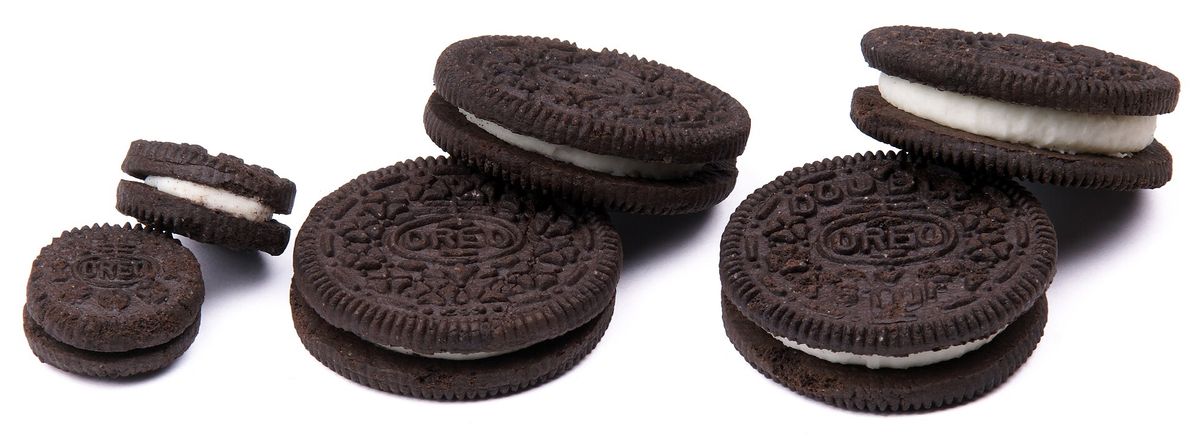
Oreo works as a master brand with a small set of permanent formats and a long tail of temporary ones. Kraft's timeline lists Double Stuf in the U.S. in 1974, Oreo "Cookies 'N Cream" ice cream licensing in 1983, Mini Oreos nationwide in 1992, the reversed "Uh-Oh!" Oreo in 2003, which was meant to be temporary but stayed because it sold, Golden Oreo in 2004 and Oreo Cakesters in 20074. Oreo Thins joined the permanent U.S. range in 201513. Gluten-free Oreo and Double Stuf followed in January 2021, certified by the Gluten Intolerance Group of North America and sold permanently wherever original Oreos are sold, CNN reported14. Mondelez's 2024 annual report mentions zero-sugar Oreos in China and new Oreo cakes15.
Inside Mondelez, Oreo sits at the top of the portfolio. In January 2020 the company said Oreo had reached $3.1 billion in annual net revenue by the end of 2019 and called it "the largest brand owned by Mondelēz International, and one of six billion-dollar brands"16.
Digital Brand Positioning and Identity
Oreo built its first large digital audience on Facebook. In 2009 it opened a global Facebook community that began in English and grew to reach fans in more than 200 countries in 10 languages, with messaging customized by country, Kraft said in 201217. On February 15, 2011 an Oreo post collected 114,619 likes in 24 hours, which Guinness World Records recognized as a record4. The community passed 25 million fans by May 201217 and 42 million by 2017, according to Mondelez's fact sheet that year18. How the brand used that audience is covered under digital marketing below.
Premium and Limited Edition Positioning
Oreo's special editions usually sell at ordinary prices. When Mondelez launched Oreo Thins in the U.S. as a "sophisticated" snack for grown-ups, it priced them the same as regular Oreos13. What the limited editions sell is novelty and scarcity. In 2017 Oreo was producing 10 to 14 limited-edition flavors a year, each on shelves for eight to 10 weeks, some only at particular retailers such as Dollar General, The New York Times reported19. "Everyone loves the classic Oreo," brand manager Madeline Vincent told the paper. "We don't mess with that."19 Some flavors go only to certain retailers or regions because Oreo expects them to do better there. "We consider a variety of factors to determine the right flavors for the right markets and partners, such as customer feedback and consumer preference," Vincent said19. The Supreme cookies of 2020, reportedly $8 for three and sold only in Supreme stores, were a rare exception on price20.
Global Brand Consistency and Local Adaptation
Oreo's global message and its local products pull in different directions by design. "The twist, lick and dunk of an OREO brings people together with a universal ritual cherished in more than 100 countries where OREO is sold," Kraft chief executive Irene Rosenfeld said in 201217. For years, Kraft said, advertising outside the U.S. consisted of American ads with a local voiceover or reshot with local actors. From 2008 the brand made ads that told culturally relevant local stories while keeping the "twist, lick, dunk" framework, and it described its approach as "glocal"17. The products and prices are where the local work shows most, as the global expansion section describes.
Brand Differentiation in the Cookie Category
Oreo's first competitor still defines its position. KCUR reports that when Nabisco raised the price of Oreos in the 1950s, shoppers came to see the now cheaper Hydrox as the budget knockoff, a result Parks called reverse psychology at its finest3. By 2008 Oreo was America's best-selling cookie according to the market research firm Information Resources, with Chips Ahoy a distant second, The Seattle Times reported21.
The modern threat is cheaper store brands. "If [another brand] is $1 cheaper than an Oreo, how do you compete with that?" Gartner analyst Brad Jashinsky told Modern Retail in 2024. "I think these collaborations, new flavors and unique designs provide another reason to stick with the Oreo brand than the store brand."22 Mondelez's annual report makes the same point in its own terms: it says it must offer an effective value proposition to compete against retailer and other economy brands15.
Brand Messaging and Communication Strategy
Oreo has changed its umbrella message every few years while keeping the ritual underneath. Mondelez's 2017 fact sheet lists "Wonderfilled" in 2013, "Play with Oreo" in 2015, "Open Up with Oreo" in 2016, which ran in more than 50 countries, and the "Oreo Dunk Challenge" in 201718. MediaPost reported that the Wonderfilled platform also carried "We Are Oreo People" in 2018 before The Martin Agency replaced it with "Stay Playful" in February 201923. Mondelez said at the time that "Playfulness has always been part of the Oreo brand's DNA, and now with 'Stay Playful,' the brand is outwardly establishing its playful spirit as the core of all creative communications"23. "Twist On It," the 2024 Super Bowl idea, was described by the brand as the start of a new platform12. Each of these campaigns is covered in the sections that follow.
Oreo's Target Market and Segmentation
Mondelez does not break out Oreo's customers or revenue in its annual report15. So there are no official percentages for Oreo's audience by age or income. What the company has said and done does show who it is aiming at.
Adults, by policy. Mondelez says it does not advertise its products "in any media primarily directed to children under age 13," and that the policy covers any advertising where 30 percent or more of the audience is under 13. It also says all of its communications on packaging and in-store materials are directed to adults24.
Grown-ups who remember being kids. A year after Chen's "carefree innocence of childhood" line, brand director Janda Lukin described the Wonderfilled campaign to CreativityOnline in the same terms: "Kids already have a sense of wonder in how they see the world, but adults have to be reminded of that," she said. "The stories are going to resonate with different people, but overall, it's an adult campaign."25
Families and parents. Kraft said in 2012 that the makers of Oreo had learned that "slowed-down, carefree family moments were increasingly rare and cherished by moms everywhere," and that this insight led to the first "moments" TV campaign in 198917. When Oreo launched Stay Playful with Wiz Khalifa and his five-year-old son in 2019, Marketing Dive's analysis was that the casting could help the brand build a following among millennial parents26.
Adults who want a lighter version. Mondelez described Oreo Thins as a "sophisticated" snack for grown-ups when they arrived in the U.S. in July 2015, and said they were not designed to be twisted open or dunked. In China, where Thins launched first, the company said they helped win back "lapsed users," including younger women who wanted something less rich13.
Gen Z. In 2025 Oreo's U.S. vice president, Michelle Deignan, told CNN that the Post Malone cookie brought in new customers and grew awareness among Gen Z, and that the brand chose another musician, Selena Gomez, because music is that group's number one "passion point"27.
Lapsed and occasional buyers. Limited editions reach people the core cookie misses. In 2024 Rachel Lawson, director of shopper marketing at Mondelez, told Modern Retail that 28 percent of people who buy limited-edition Oreos don't buy regular Oreos, and that 15 to 17 percent of people who bought Space Dunk cookies at grocery stores that February had not bought an Oreo there in more than two years22.
Local markets. Oreo was mainly a North American brand for its first seven decades. By 2012 it was sold in about 85 developing markets17, and in 2016 its biggest markets by sales were the U.S., China, the UK, Indonesia, Canada, Mexico, Spain, Argentina, India and Germany18.
Fans of other brands. Collaborations borrow an audience for a few weeks: streetwear buyers with Supreme, collectors with Pokemon, music fans with Lady Gaga, Post Malone and Selena Gomez, and soft drink fans with Coca-Cola.
The Oreo Marketing Mix: The 4Ps
Product
The core product has barely moved. "The original OREO cookie has not changed much since its introduction," Kraft said in 2012, and it remained the top-selling variety worldwide17. Around it sit the permanent formats listed above and a steady run of limited editions. New versions are tested before they reach shelves. "We do product testing with consumers so that whenever we're launching new products, we ensure they meet or exceed expectations in terms of taste and colour," Murl told Strategy in 20089. Some changes are harder to make than they look. When Mondelez developed Oreo Thins, 60 percent of the cookies broke early on, and it took months to bring the rate down to 3 percent, Janda Lukin, then senior director of Oreo for North America, told CNBC13.
Price
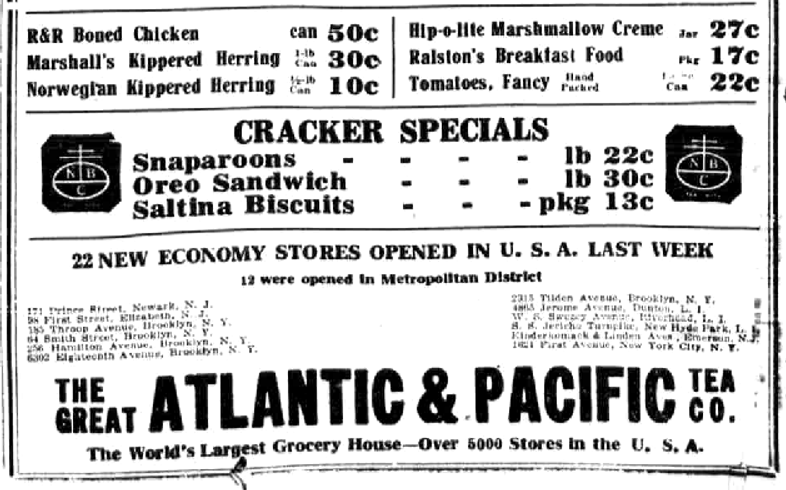
Oreo has always been priced as an everyday grocery item. Grocers paid 30 cents a pound in 19124, and the A&P ad above shows the same price to shoppers ten years later. In emerging markets the brand has cut pack sizes to reach a price people will pay. In China, Kraft found that 5 yuan for 14 cookies was too expensive and the pack too big, so it repacked Oreo as seven cookies for 2 yuan, Kraft International president Sanjay Khosla told Forbes in 200928. In India, Oreo launched in 2011 at price points of 5, 10 and 20 rupees29. When Mondelez began making Oreo in Russia in 2015, it promised "affordable pricing" and sold the cookie in 38-gram single packs as well as 95-gram and 228-gram bags30.
In the U.S., new formats have tended to launch at the familiar price. Mondelez said Oreo Thins would cost the same as regular Oreos13, and packs of the 2021 Pokemon cookies sold in stores for less than $431. Price support runs through retailers: Mondelez groups its marketing into consumer advertising, consumer incentives such as coupons and rebates, and trade promotions "to support price features, displays and other merchandising" by its customers15.
Pricing pressure has grown. Mondelez's net revenues were about $36.4 billion in 2024, and the company said the increase was driven by higher net pricing15. In February 2025 chief executive Dirk Van de Put said the company was navigating "unprecedented cocoa cost inflation" and left open the possibility of raising prices again later in the year or the next, if cocoa costs stayed high32.
Place
Oreo reaches shoppers through a wide range of retail channels. Mondelez says it sells to supermarket chains, wholesalers, supercenters, club stores, mass merchandisers, convenience stores, gas stations, drug stores and value stores, and directly to businesses and consumers through e-retail platforms, retailer digital platforms, its own direct-to-consumer websites and social media platforms. Its distribution network includes direct store delivery15. The brand says Oreo is available in more than 100 countries33, and in 2017 Mondelez said more than 40 billion Oreos a year were produced in 18 countries18.
Distribution is also a promotional tool. Limited editions are sold through most major supermarkets and through Target, Instacart, UberEats and Amazon, and Oreo displays them alongside the core range because they lift sales of regular Oreos, Modern Retail reported22. The Supreme cookies went only through Supreme stores20, while the 2024 Coca-Cola collaboration went into grocery and convenience stores, with a frozen drink version at McDonald's and 7-Eleven in select markets34.
Promotion
Oreo's promotion keeps returning to the way people eat it. Mondelez's marketing, by its own description, spans consumer advertising "including digital and social media, on-air, print, outdoor and other product promotions," plus coupons, rebates and trade promotions15. The sections below cover the campaigns: digital and social work, TV and partnerships, events and games.
Digital Marketing and Social Media Excellence
Creative Content Marketing Campaigns
The Daily Twist. For the 100th birthday in 2012, Oreo ran a new digital ad every day for 100 days, from June 25 to October 2. Each one reinterpreted a news story, pop culture moment or anniversary using the cookie and, often, a glass of milk. Subjects in the first months included Pride parades, Bastille Day and the Mars rover landing. The work came from DraftFCB for advertising, 360i for digital, Weber Shandwick for public relations and MediaVest for media10.
The first day's ad, posted on Monday, June 25, showed an Oreo with six layers of rainbow-colored creme and the caption "Proudly support love!" Within 17 hours more than 157,000 people had liked it, 40,000 had shared it and 20,000 had commented, ABC News reported. Many comments were supportive, and some Facebook users pledged to boycott the cookie. Kraft stood by the post. "As a company, Kraft Foods has a proud history of celebrating diversity and inclusiveness. We feel the OREO ad is a fun reflection of our values," a spokeswoman said35.
The series ended live in Times Square. Creatives from Draftfcb and 360i worked in a glass box on the last of the 100 ads, on a topic suggested and voted up by fans on social media: the anniversary of the first high five36. The campaign also changed how the brand worked. "So Oreo got the muscle memory because of Daily Twist," 360i chief executive Sarah Hofstetter told Digiday. "We started experimenting with commenting on culture."1
Dunk in the Dark. By the 2013 Super Bowl, Oreo had bought its first in-game spot, a 30-second ad called "Whisper Fight"33. Made by Wieden + Kennedy, it opened a two-month "Cookie vs. Creme" program in which fans could vote by text for a chance to win $100,00037. "We knew we wanted to kick off the next 100 years for OREO in a big way, and what better way than by bringing the long-standing disagreement of cookie versus creme to one of America's biggest television events," Mann said in the launch release37. The agency had daily content calendars, posts prepared for the anthem and the halftime show, and a dry run the day before the game1.
"Because we picked such a big stage, we decided to have a social media command center, so that we could respond real time to buzz," Mann told Forbes the next day. "Of course we couldn't have anticipated the blackout, but in that command center we had brand people, agency people." It sat in 360i's Tribeca offices, with people from Wieden + Kennedy, MediaVest and Weber Shandwick as well as the brand team38. Ad Age reported that the blackout image was "designed, captioned and approved within minutes," and that the tweet was retweeted 10,000 times in one hour2. By the next morning Forbes counted almost 15,000 retweets, about 8,000 new Twitter followers and nearly 20,000 Facebook likes for the blackout post, while Oreo's Instagram following had grown from 2,000 before the game to 36,00038. The retweet and like totals built up over the evening and night; the first-hour figure was 10,000 retweets.
The Instagram side of the campaign was its own experiment. Fans posted photos tagged #cookiethis or #cremethis, and a team of artists in Portland, Oregon turned chosen submissions into sculptures made of cookie or creme, which Oreo photographed and posted. By the Tuesday after the game, nearly 32,000 fan submissions had produced 122 sculptures and the account had about 53,000 followers, ClickZ reported. "It's very visual, it's something that's unique and it's something Oreo hasn't done before," said Susan Burris, a senior associate brand manager at Mondelez39. Wieden + Kennedy closed the campaign in March with SuperImportantTest.com, which answered every cookie-or-creme vote with one of more than 30 short, silly videos40.
Snack Hacks and SXSW. In 2014 Oreo turned six-second Vine clips of cookie tricks, called Snack Hacks, into a YouTube series with chefs Michael Voltaggio, Roy Choi and Nguyen Tran, produced with 360i41. That March at SXSW in Austin, two vending machines 3D-printed custom Oreos based on trending Twitter conversations, with 12 creme flavors and colors to choose from42,43. Oreo was now "connecting trending moments to the cookie itself in real time and in real life," said Bonin Bough, Mondelez's vice president of global media and consumer engagement42.
Colorfilled. In November 2015 Oreo let fans design their own packs online for the holidays, at $10 plus $5 shipping, using illustrations by the graphic artists Jeremyville and Timothy Goodman44,45. "Our fans have been interacting and getting creative with OREO cookies for more than 100 years so bringing this behavior to our pack was a natural next step," said Lukin, by then senior director for Oreo45. Chen, by then Mondelez's global head of e-commerce, called it "the first step in a larger e-commerce and customization strategy" toward a goal of $1 billion in e-commerce revenue by 202045.
The Backlash Against Real-Time Marketing
The blackout tweet set off a wave of imitation, and the industry soon turned on the idea. Andrew Teman, a strategist at Hill Holliday, had said he would quit advertising if the tweet won at Cannes, and he did. "I think the Oreo work is wonderful, but it took too many people. At the end of the day, it was a tweet, a picture," he told Digiday in 2013. "I was sitting at Hill Holliday getting brief after brief that said, 'Do the Oreo thing.'"46
Before the next Super Bowl, TIME's Brad Tuttle explained that Oreo had pulled it off because it had "a team monitoring the game in something of a mission control room," and predicted a flood of copycats anyway: "It will be difficult, if not impossible, for anyone to match Oreo's success from last year, if for no other reason than the basic idea of clever, real-time, reactionary marketing is now old."47 By 2015 even 360i had moved on. "It was an uncluttered environment, and it was new, which made it cool," chairman Bryan Wiener told The Globe and Mail. "It went way overboard, real quick. And guess what happens when everybody rushes to a party – it gets uncool quickly, and crowded." His agency was "moving more toward campaign-style content, where it's fewer, bigger, better," he said48. Around the same time, the content marketing firm Contently argued that a brand operation producing a modest stream of memes tied to predictable events did not look much like a real newsroom, and did not necessarily produce a return on investment49.
Influencer Partnerships and User-Generated Content
Oreo's most direct use of fan ideas was the My Oreo Creation contest. Launched in May 2017, it asked people to post flavor ideas with #MyOreoCreation for a $500,000 prize. Mondelez planned a "playful conversation with our fans," brand manager Madeline Vincent told Advertising Age, as quoted by CBS News50. The brand said the contest drew hundreds of thousands of ideas, and it made hundreds of prototypes, surprising some fans with custom samples of their own submissions. "We were blown away by not only the volume of flavor ideas we received as part of our #MyOreoCreation Contest, but also by the creativity and imagination of our fans," said Pam Clarkson, associate director of North American Oreo equity51. Three finalists, Cherry Cola, Kettle Corn and Piña Colada Oreo Thins, went on sale in April 2018 for fans to vote on51, and Cherry Cola's creator, Eden Folwell of California, won the $500,000 that August52. The brand followed with a Mystery Oreo sweepstakes in 2019, which ended with the flavor revealed as churro and a $50,000 prize for one correct guesser53.
Oreo also used social creators. Its 2018 "Some People'll Do Anything for an Oreo" campaign featured influencers modeling "OreoBrows" and the YouTube channel Slow Mo Guys, whose video of a fall into a pool of milk passed 900,000 views in four days, Marketing Dive reported26.
In June 2020 the brand began #ProudParent with PFLAG, the U.S. organization for LGBTQ+ people and their families. With Pride parades canceled by the pandemic, it bought outdoor ads along the empty parade routes in New York and San Francisco showing signs that proud parents had carried in earlier marches54. In October released a film, Proud Parent, along with 10,000 packs of rainbow cookies given to fans who shared what allyship meant to them55. "OREO believes that a loving world starts with a loving home," said Parnell55. In its Shorty Awards entry, the brand reported more than 315 million total impressions, 87 million of them paid, and 2 million organic engagements54.
Product Innovation and Limited Edition Strategies
Limited editions are Oreo's main engine of news. Since the Birthday Cake Oreo in 2012, the brand had introduced 65 flavors by the end of 2020, The New York Times reported, including Hot Chicken Wing and Wasabi Oreos released in China56. A team of about half a dozen people works on them, and its name is kept secret. "Their job is really how do we continue to excite our fans and drive growth through flavor innovation," Parnell told the paper56.
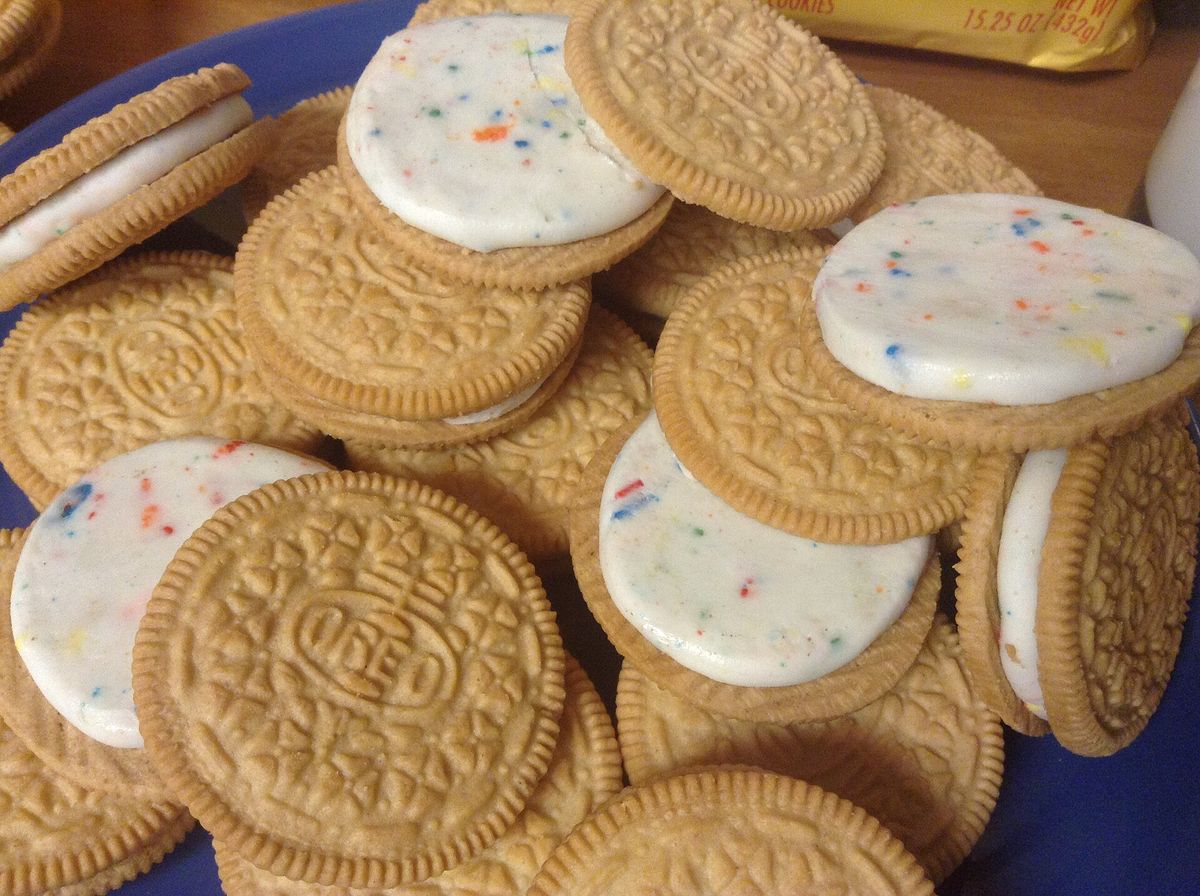
The novelty sells the original. According to Nielsen figures cited by the Times, sales of flavored, seasonal and other novelty Oreos rose more than 12 percent over three years, while sales of the classic rose almost 22 percent. "When we do it well, it drives our classic Oreo cookie, as well as the sales of the limited edition," Parnell said. The pandemic helped: "Definitely snacking has been one of the stories of Covid," NPD Group analyst Darren Seifer told the paper56. Mondelez's Lawson made the same point in 2024: "In a way, limited edition is an opportunity to remind shoppers about Oreo in general," she said. "The limited edition is a stopping power, but the intention is for you to buy an Oreo."22 By then Oreo was launching a limited edition every month or two, most staying on shelves for up to six to eight weeks; 2024's list included Coca-Cola, Mint Chip, Star Wars, Sour Patch Kids, Churro, Tiramisu, Dirt Cake and Space Dunk22. On an earnings call that July, Van de Put said Oreo was "gaining share year-to-date" in the U.S. and "driving incremental lift" through its limited editions22.
The pipeline is planned years ahead. Allison Kristofco, a senior product change manager at Mondelez, described it in December 2024: marketing and research teams work with suppliers on trends, the lab makes samples, focus groups test them and leadership approves a launch calendar. Formulations that are proven but not used go into what the team calls the "Oreo Bank." "Oreo is such an iconic brand, and consumers have very specific expectations for what they'll get when they buy them. Our challenge is to balance something new and exciting with the same familiarity that people are expecting with an Oreo," she said, adding that it "can take two years to take something from an idea to the shelf." A relaunch of Cotton Candy Oreos in 2023 took under four months because the recipe was already in the bank57.
Seasonal and Holiday-Themed Products
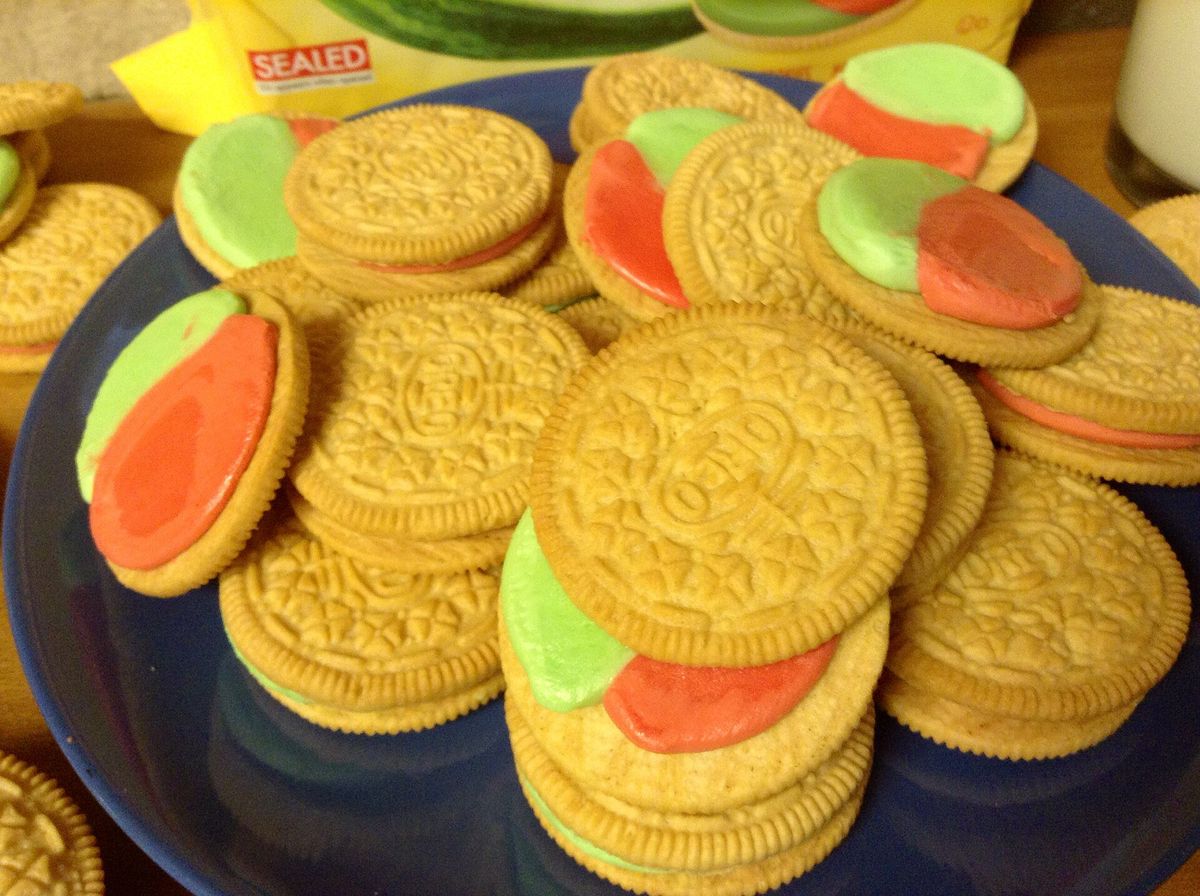
Seasonal Oreos predate the flavor boom. Kraft's timeline records Oreo Mint Creme as a limited-time U.S. product in 1985, an Oreo Summer Fun Pack in Canada in 1990 that sold more than 900,000 packages in three weeks, orange-filled Halloween Oreos in the U.S. in 1991, Mini Oreos with red filling for the 1993 holidays, red-creme holiday Oreos in 1995 and Football Oreos as a temporary product in 20044. In Canada, Strategy reported limited-edition holiday packs with colored creams and Halloween Oreos with orange filling in 19929.
Global Flavor Adaptations for Local Markets
Local flavors are where Oreo's product strategy departs furthest from the American original. Kraft's 2012 fact sheet listed green tea ice cream Oreos, wafer Oreos and double-fruit Oreos in China; blueberry and orange ice cream Oreos in Indonesia; the three-layer Oreo x3, the Oreo Duo with banana and dulce de leche creme and an Oreo Alfajor in Argentina; and the Oreo Trio Chocolate in Mexico4. The Argentine x3, Kraft noted, inspired the U.S. Triple Double Oreo4. By 2017 China's range also included Oreo Thinwich sandwiches with lemon cheese, green tea and tiramisu creme18.
China is the clearest case. "Chinese consumers found the U.S. Oreo too sweet, so we made it less sweet," Khosla told Forbes in 2009. Kraft also launched Oreo Wafer Sticks, Wafer Rolls, Soft Cakes and Strawberry Creme there, and according to ACNielsen China became the largest Oreo market outside the United States, with 41.9 percent growth in measured consumption over the year28. Russia got its own recipe too: when local production began in 2015, a Mondelez spokesman said the Russian Oreo had a slightly sweeter biscuit and filling than the U.S. version30. In April 2023 Oreo released a Blackpink edition in seven Asian markets, including Vietnam and Thailand22.
Traditional Advertising and Brand Partnerships
Memorable TV Commercials and Print Ads
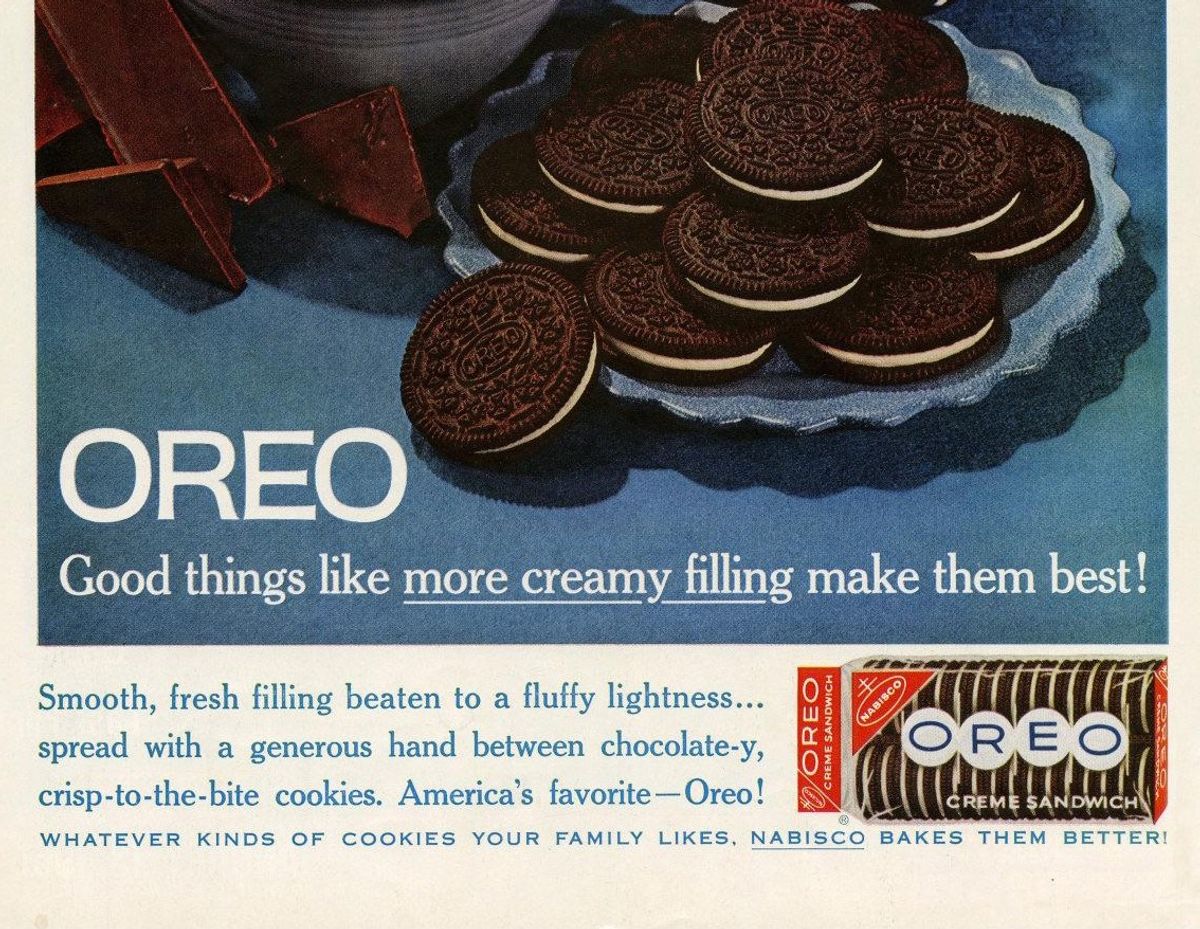
Oreo was a print and trolley-car brand before it was a TV brand. The 1961 magazine ad below, for what was then the Oreo Creme Sandwich, sold the filling and called the cookie "America's favorite."
Television built the ritual into family scenes. Kraft's timeline marks the "Father and Son" commercial of 1989 as the launch of the "Moments" campaign, and a Global Moments campaign in 19984. The Double Stuf Racing League, launched in January 2008, turned twisting, licking and dunking into a mock sport; by 2010 its best-known competitors were Peyton and Eli Manning58. In January 2010 the league staged a lick race between the Mannings and Donald Trump, who had "challenged the quarterback brothers to lick-off for the DSRL after Oreo rejected his bid to buy the league," with up to 150,000 coupons for free Golden Double Stuf packs promised to Facebook fans if the Mannings won58. "I usually get what I want and I want the Oreo Double Stuf Racing League," Trump said in the release58.
Wonderfilled, in May 2013, was Oreo's first campaign from The Martin Agency. The 90-second animated spot debuted during "Mad Men" and asked what might happen if you gave an Oreo to the Big Bad Wolf or a vampire. Its anthem was written by Martin Agency creative director Dave Muhlenfeld and sung by Adam Young of Owl City25. On launch day 500 a cappella singers performed it around New York before a sing-along with Owl City in Union Square59. "The OREO WONDERFILLED campaign has a much more universal message, asking people to see the world the way OREO does – with openness and curiosity," Lukin said59.
The Oreo Dunk Challenge of 2017 ran in more than 50 countries with Shaquille O'Neal, Christina Aguilera and the Brazilian footballer Neymar performing stunt dunks. "People across this country grew up dunking Oreo cookies in milk. Our goal is to not only recapture the simple magic of those moments but to do so in a way that feels novel and fresh," said Patty Gonzalez, director of Oreo equity in North America60. Fans entered by posting their own dunks with #OreoDunkSweepstakes, and the official rules said the winners would be drawn by dropping Oreos from drones into cups60. The campaign also used a Snapchat lens, the NCAA Final Four Fan Fest in Phoenix and takeovers of Live With Kelly, Jimmy Kimmel Live and The Chew. Kerri McCarthy, Oreo's senior global brand manager, said the campaign had "a very simple mission": getting millions of people to dunk Oreos in milk "as a way to reconnect with the kid inside"61.
Stay Playful arrived at the 2019 Grammy Awards with Wiz Khalifa and his son Sebastian in a spot about a busy father who makes time to play. Khalifa recorded an original song for it, which Oreo released on a limited-edition music box that played when a cookie was placed on its turntable26.
Oreo returned to the Super Bowl in February 2024 with its second-ever in-game spot33. "Twist On It," again from The Martin Agency, starred Kris Jenner and showed moments in history decided by which side the creme landed on when an Oreo was twisted apart. "We see it as the beginning of a new platform for Oreo, and the Big Game is a place for us to help launch it. But I think it has a lot of longevity," Deignan told Adweek12.
Strategic Collaborations with Other Brands
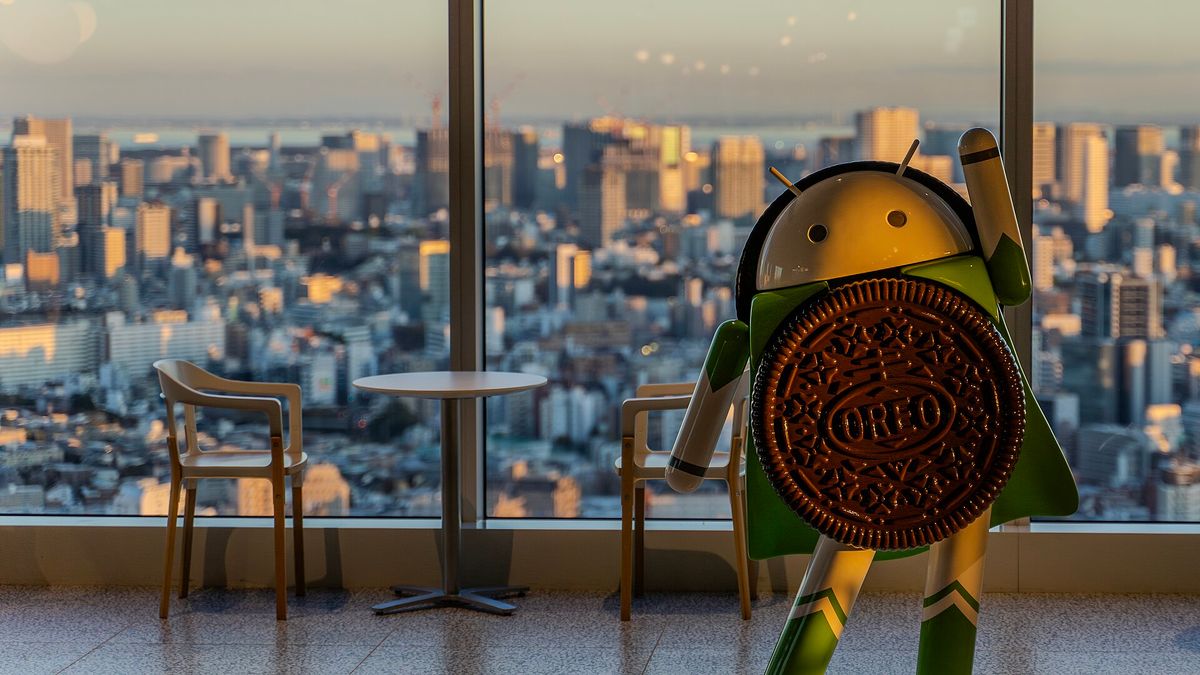
Oreo's first global movie partnership was with Paramount Pictures for "Transformers: Age of Extinction" in 2014, covering more than 35 countries, according to Mondelez18. In August 2017 Google named the new version of its mobile operating system Android Oreo, a global collaboration that came with an Android Oreo superhero character62.
For the final season of Game of Thrones in April 2019, Oreo and 360i worked with Elastic, the studio behind the show's opening credits, to rebuild the title sequence from 2,750 cookies, and sold packs embossed with the emblems of the show's houses. Fans could pledge loyalty to House Lannister, House Targaryen, House Stark or the Night King on Oreo's website and social pages11. Parnell called it "certainly" Oreo's biggest collaboration of the year and possibly its biggest ever, and explained the fit through the show's audience. "It's definitely a community that's all about social connections and that's what makes it relevant for Oreo," he said11.
The Supreme drop followed in February 2020. Red cookies stamped with Supreme's logo, reportedly $8 for three, drew an eBay bid of $10,800 on launch day20. A year later came Lady Gaga. The pink Golden Oreos with green creme were inspired by her album "Chromatica," and Oreo became a sponsor of her Born This Way Foundation. "This collab is inspired by the world of Chromatica, where kindness rules all things," Lady Gaga said. From December 2020 to April 2021 a companion promotion, Sing It With OREO, invited fans to send musical "OREOgrams" to loved ones63. "Over the last few years, music has become a key element of our purpose to spread more joy and playfulness in the world through partnerships and entertainment properties alike," Parnell said63. The team treated the release "like a shoe drop," he later told Variety64.
In September 2021 Oreo released cookies embossed with 16 Pokemon characters. "The rarity of the designs embossed on the cookies range from easy to find to hard to find, and the hardest to find (Mew) is featured on an extremely limited amount of the total cookies produced," Oreo said65. NPR found Mew cookies listed on eBay at up to $100,000 and some sold for more than $15,00031.
In August 2024 Oreo and Coca-Cola announced an Oreo Coca-Cola Sandwich Cookie and a Coca-Cola Oreo Zero Sugar drink. "At OREO, we strive to identify fresh ways to excite consumers and, with this collaboration, we have truly upped the ante," said Eugenia Zalis, Oreo's global head of marketing and brand at Mondelez34. In Europe that year, Oreo and Pac-Man ran a campaign across 42 countries in which each special cookie could be scanned to unlock games66. "At OREO, we are on a mission to fill the world with more playful moments that bring people together. And this year, we dialed this up by turning our OREO cookie itself into a game," said Perrine Willaey, a Mondelez marketing director67.
The 2025 collaborations were built around musicians. Post Malone's cookie, announced in January, had the first twisted creme in Oreo history, salted caramel and shortbread between one chocolate and one golden wafer68. Selena Gomez's followed in May, with chocolate and cinnamon creme and six embossments, one of them her signature, the first autograph ever put on an Oreo. Development took about 18 months, Deignan told CNN. "What we've seen is bringing credible partnership, like Selena, makes it worth it for consumers to part with their hard-earned cash," she said27.
Experiential Marketing and Consumer Engagement
Interactive Pop-Up Events and Experiences
Oreo has repeatedly taken its brand stories into streets and stores. The Wonderfilled launch put a cappella groups on New York streets and then in Chicago and Los Angeles59, and the Daily Twist finale turned an ad agency's work into a Times Square exhibit36.
In February 2016 Oreo opened the "Wonder Vault," a one-day pop-up behind a garage door in Chelsea, to reveal a Filled Cupcake flavor. More than 900 people stopped by. "While we're determined to keep some of the mystery alive, we were excited to give consumers a peek into what goes into our flavors with a real-world installation," said Elise Burditt, brand manager of Oreo North America69. When Most Stuf Oreos returned in 2020, the campaign included a $100,000 online contest, a TikTok hashtag challenge and pop-ups in New York, Atlanta and Los Angeles with rides on a three-story slide70.
The most elaborate stunt was the Global Oreo Vault. In October 2020, with a small asteroid due to pass Earth the day before the U.S. election, Oreo built a concrete vault on permafrost in Svalbard, Norway, near the Global Seed Vault, and stored cookies inside in Mylar wrappers71. The project began with a fan's tweet asking who would save the Oreos71. The D&AD Awards recognized it in 2021, where the entry claimed more than 415 earned media placements and 100 million impressions. "I just loved how sincerely they went about creating something of epic proportions just as a reaction to a single Tweet," said juror Emmanuel Upputuru of Cheil India72.
Employees became part of the show too. On January 30, 2020, Mondelez set a Guinness World Records title for the most people dunking cookies across multiple venues, with 5,066 employees in 55 locations and 32 countries, to mark Oreo's $3.1 billion milestone. "We're incredibly proud to be celebrating this sales milestone with the OREO brand, and taking a playful moment to recognize this achievement with the full Mondelēz International family around the world," said Van de Put16. In stores, Mondelez staged Star Wars Oreo events in 2024 at Stop & Shop, Giant Food and Hannaford locations, where fans could have their photo taken with Stuffy, the Oreo mascot22.
Mobile Apps and Digital Games
Oreo's first gaming app, "OREO: Twist, Lick, Dunk," arrived in November 2012. "We are delighted here at OREO to release our first gaming app," Chen said73. In 2017 Oreo and Google launched Oreo Space Dunk, in which players scanned a real cookie and swung their phones to launch a virtual Oreo through Google Earth into a cup of milk somewhere on Street View74. "Our deep collaboration with OREO and their agencies represents a solid model for the future of brand advertising in the digital space," said Michael Yapp, director of The ZOO at Google74.
The 2024 Space Dunk cookie took the theme literally. Each cookie had blue and pink creme with popping candy, one of five space-themed embossments and, for the first time in Oreo history, a small cut-out in the wafer, and the packs carried a QR code for a sweepstakes to send one fan to the edge of space with the balloon flight company Space Perspective. "Through this campaign we hope to take playfulness to new heights, proving it is not only in all of us, but also exists in space," Deignan said75. In January 2025 the brand launched "Name This Oreo," a web game built by VML in which players read stacks of "O" and "RE" aloud into their phone's microphone before a timer ran out, for Kroger offers76.
Global Expansion and Localization Tactics
From American Cookie to Global Brand
Oreo's international history is long but its global scale is recent. Kraft's timeline records exports to Spanish-speaking countries in Central and Latin America in 1928, a Canadian launch in 1949, Venezuela in the late 1960s, 30 countries by 1993, China in 1996, the UK in 2008, and India, Germany and Poland in 20114. Mondelez's 2017 fact sheet added Brazil and Pakistan in 2013 and Morocco and Russia in 201518. Oreo was a billion-dollar brand by 2007 and a $2 billion brand by 2011, the same fact sheet says18. After its first 95 years Oreo had less than $200 million in annual revenue in developing markets; Kraft planned to reach $1 billion there in 201217.
Strategic Distribution Through Mondelez Infrastructure
Acquisitions did much of the work. In 2006 Kraft regained the rights to Nabisco trademarks, including Oreo, in the European Union, Eastern Europe, the Middle East and Africa. In 2007 it bought Danone's global biscuit business, which strengthened Oreo in China, Russia, Poland, Indonesia and Malaysia, and the 2010 purchase of Cadbury enabled the launch in India17. In China, Khosla said, the combined business expanded distribution from 80,000 outlets to more than 133,000 in six months28.
Local manufacturing followed. In 2012 Oreo was made at 21 bakeries around the world4. In 2013 Mondelez opened an Oreo line in Sheffield, England, capable of more than a million cookies in 24 hours; at the time the company said UK Oreo sales were worth £22 million and growing 16 percent a year. "We know that Britain is a nation of biscuit lovers – it is currently the biggest biscuit market in EU," said Maurizio Brusadelli, Mondelez's president for the UK and Ireland77. In Russia, production began in 2015 at an upgraded plant in Sobinka, backed by plans for national distribution and full marketing support. Oreo had previously reached Russia only through sporadic imports; Mondelez already led the fragmented Russian biscuit market, with a 5.8 percent share according to Euromonitor figures cited by ConfectioneryNews30.
Japan went the other way. From 1970 Oreo was sold there under licence by Yamazaki Nabisco, a joint venture with Yamazaki Baking. In February 2016 Yamazaki said the 46-year arrangement would end that August, with Mondelez Japan taking over marketing of Oreo, Ritz and Premium from September. "It's an exciting opportunity for us to bring an expanded brand portfolio to delight consumers in Japan with the return of the Nabisco snacks brand, Oreo cookies and Ritz and Premium crackers," said Mondelez Japan managing director Heizo Hotori78.
Culturally Sensitive Marketing Campaigns
India shows the playbook in one market. Cadbury India launched Oreo in March 2011, aiming "to make the world's favourite biscuit, Oreo, one of India's favourite biscuits," and planned to sell it through "hundreds of thousands of retail outlets across urban and semi-urban markets"29. The biscuit market it entered was estimated at 12,000 crore rupees and, citing an AC Nielsen study, the company said it had grown 17 percent in 2010, with Parle, Britannia and Priya Gold among the major players. Oreo was the second Kraft product Cadbury India introduced, after Tang. "The Indian biscuits market continues to show remarkable growth, a testament to rapidly developing consumer tastes that provides us the perfect opportunity to enter this category," said Anand Kripalu, managing director of Cadbury India29. Its first TV ad, released during the 2011 Cricket World Cup, introduced the twist, lick and dunk ritual through a father and daughter, and an Oreo Togetherness Bus toured nine cities that June to promote parent-child bonding, Social Samosa reported79. In 2015 the brand ran Play with Oreo in India with graffiti walls by local artists in Mumbai, Delhi and Bangalore. "The 'Play with OREO' campaign will encourage people of all ages to tap into their imagination and incorporate a little more play into their daily routines," said Chella Pandyan, an associate director at Mondelez India80. Online, the campaign invited fans to post their own Oreo doodles under #DoodleIt and ran tie-ins with payment and coupon brands such as PayU and GrabOn, Social Samosa reported62.
Market Entry Pricing Strategies
Entry prices were set for local wallets. China's two-yuan pack of seven, India's five-rupee pack and Russia's 38-gram single pack, all described above, served the same purpose: letting a first-time buyer try the cookie for very little28,29,30.
Market Research and Consumer Intelligence
Oreo's local changes came from local research. Kraft's "Winning Through Focus" strategy of 2007 overturned the belief that what worked in one market would work everywhere. Khosla said the company could no longer "simply 'export' U.S. brands all over the world and expect them automatically to do well," and Kraft let local managers decide based on their understanding of the market. It also opened its largest cookie research and development center in Asia, at Suzhou Industrial Park near Shanghai28. In the U.S., Kristofco said, consumer science and marketing teams run online surveys for flavor feedback alongside focus groups, and many flavors are tested that never reach stores57.
Measuring Success: Key Performance Indicators
Sales Growth and Market Penetration
The clearest measure of Oreo's strategy is revenue, as the company has reported it. Kraft's January 2012 fact sheet put Oreo at $1.5 billion in global annual revenue4. Four months later Kraft said Oreo had grown nearly 25 percent in 2011, had averaged more than 17 percent annual growth since 2006 and had passed $2 billion in annual revenue in 201117. Mondelez put Oreo at over $2 billion in 201618 and $3.1 billion by the end of 201916.
The company's figures for how many cookies it sells have been less consistent. Mondelez said in 2017 that more than 40 billion Oreos a year were produced18, in 2020 that approximately 34 billion were sold each year16 and in December 2023 that over 60 billion were sold each year, more than 20 billion of them in the U.S.33
Share figures are scattered but telling. Kraft's timeline says Oreo became China's best-selling biscuit in 2006 and that 9 out of 10 U.S. households ate Oreos in 20004. In China, Oreo held 7.3 percent of the cookie market by value in the year to September 2009, according to ACNielsen figures reported by Forbes28. Oreo Thins generated $40 million in their first eight months in China, a Mondelez executive told CNBC13.
Social Media Engagement and Digital Reach
The social numbers show how fast the audience grew. Oreo's Facebook community went from more than 23 million fans in early 20124 to more than 25 million by May 201217, more than 33 million a year later59 and more than 42 million by 201718. The blackout tweet's almost 15,000 retweets and the jump from 2,000 to 36,000 Instagram followers overnight38 became reference points for the whole industry, as the backlash above shows.
Brand Awareness and Recall
Oreo's place in American memory was measured long before social media. In a Yankelovich Partners survey at the turn of the century, 86 percent of Americans chose Oreo cookies when asked which items they would like to see continue into the next century, second only to newspapers, Kraft reported4.
Campaign Recognition and Awards
Award juries have been a public scorecard. At Cannes Lions in 2013, Oreo work won six Lions, including the Cyber Grand Prix for the Daily Twist, a Gold Lion in PR, a Silver in Direct and a Bronze in Promo & Activation; the blackout tweet added a Silver Lion in Direct and a Bronze in Cyber81. "It made people fall in love with a cookie. If you can do that for a brand that's been around for 100 years, that's interesting," said Cyber jury president Bob Greenberg of R/GA82. The Global Oreo Vault was recognized by D&AD in 202172.
Competitive Performance Benchmarking
In China the benchmark was the local market. Kraft held 22.4 percent of China's $1.6 billion cookie market in the year to September 2009, ahead of Taiwan's Tingyi at 8.3 percent and the local leader Dali at 5.7 percent, according to ACNielsen figures reported by Forbes28.
Against its oldest rival the gap is complete, though Hydrox has kept a loyal following. When Kellogg brought Hydrox back for its 100th anniversary in 2008, the company said it had fielded more than 1,300 phone calls and received a 1,000-signature petition asking for its return21. Hydrox was replaced by a reformulated product called Droxies in 1999 before Leaf Brands revived the original name in 2015, Food Business News reported83. Against store brands, the brand's own benchmark is whether limited editions bring lapsed buyers back, which is why Mondelez tracks figures like the 28 percent of limited-edition buyers who don't buy regular Oreos22.
Where the Strategy Runs Into Trouble
A brand this big attracts criticism, and some of it goes to the heart of the marketing.
The original still wants credit. In 2015 Leaf Brands, run by Ellia Kassoff, relaunched Hydrox after claiming the unused trademark from Kellogg's84. Kassoff has said it is hard to get space in mainstream stores, and in 2018 Leaf Brands filed a complaint with the Federal Trade Commission alleging that Mondelez workers, who restock shelves through the company's direct-store-delivery system, were hiding Hydrox packages83. KCUR reported that Leaf Brands asked for $800 million in damages and that as of March 2024 Kassoff was still waiting for a formal response. Mondelez's reply: "Our shelf placement in stores stems from the fact that Oreo is the No. 1 cookie in the US, loved by consumers, and retailers."3
The recipe drew a lawsuit. In May 2003 San Francisco lawyer Stephen Joseph sued Kraft to stop the sale of Oreos to children in California because they contained trans fat, which the National Academy of Sciences had linked to heart disease85. Days later he said he would drop the suit, after Kraft confirmed it was working on ways to reduce trans fat in the cookie; he called Kraft's move "a home run" for public awareness86. Kraft's timeline records Reduced Fat Oreos reformulated to zero grams of trans fat per serving in 20044.
Taking a position invites a backlash. The rainbow Oreo of 2012 drew boycott pledges alongside hundreds of thousands of likes, and Kraft chose to stand by it35. Real-time comment on culture, the habit that made the blackout tweet possible, means the brand is sometimes on one side of a live argument.
Where the cookies are made is a marketing issue. In 2015 Mondelez announced a $130 million investment in new production lines in Salinas, Mexico, replacing lines at its Chicago bakery and cutting 600 jobs there. The company said the new lines would cost $46 million less per year than in Chicago, and only two of the four would make Oreos. Donald Trump, then a presidential candidate, told a rally in Alabama he would stop eating Oreos, and later repeated it: "I'm never eating Oreos again." Fortune noted that his claim that Nabisco was closing the Chicago plant was untrue: Mondelez was keeping it open87.
The people who bake the cookies went on strike. In August 2021 workers at Nabisco's Portland, Oregon bakery walked out after contract talks broke down, and the strike spread to Colorado, Illinois, Virginia and Georgia. A union business agent said a sticking point was a proposal to move employees to a seven-day, alternating shift schedule without weekend overtime pay88. It was the company's first strike in 52 years, involving about 1,050 workers, and it ended in September when members approved a four-year contract with pay rises and a larger 401(k) match, CBS News reported89. The Pokemon cookies launched while it was under way, and some fans said they would stay away until it ended31.

Costs pressure the everyday price. A cookie positioned as an affordable treat is exposed when ingredients spike. Mondelez's 2025 warning about cocoa costs and possible further price increases puts that position under strain32.
Crisis Response and Reputation Management
Mondelez's replies in these episodes follow a pattern: stand by the brand's values when the issue is marketing, and defend the business case when the issue is operations. Kraft called the rainbow Oreo "a fun reflection of our values"35. On Hydrox, a Mondelez spokesperson said in 2018: "We have not been contacted about this, but we are confident that this accusation has no merit."83 During the strike the company said it had "activated our robust business continuity plan" to keep supplying retailers88, and when it ended, Mondelez executive vice president Glen Walter said its goal had been agreements that "would provide our union-represented colleagues with good wages and competitive benefits, while also positioning our U.S. bakeries and sales distribution facilities for future growth and success"89.
Sustainability and Social Responsibility
Mondelez reports its environmental and social commitments at company level, and publishes little that is specific to Oreo. Its 2024 annual report describes efforts to sustainably source key ingredients, reduce its environmental impact and innovate its processes and packaging to reduce waste and promote recycling15. For Oreo the most visible responsibility commitments are in marketing: the policy against advertising in children's media24 and cause partnerships such as #ProudParent with PFLAG55 and the Lady Gaga collaboration's sponsorship of the Born This Way Foundation63.
Conclusion: Lessons From the Oreo Strategy
Prepare for the moment you can't schedule. The blackout tweet took under a minute to write and two years to make possible: a war room, an approval chain and a team that had practised on 100 Daily Twists1.
Know when a tactic has worn out. Within two years the agency behind the tweet was arguing for "fewer, bigger, better" campaigns48.
Own a behavior. Twisting, licking and dunking is something customers already did. Oreo has advertised it since 19234 and was still building a Super Bowl campaign around it in 202412.
Talk to the adult about the child. Mondelez keeps its advertising out of children's media24, and Oreo has built campaigns such as Wonderfilled that sell childhood wonder to grown-ups25.
Keep the center fixed and change the edges. The original cookie has changed little17, and the limited editions around it exist partly to sell that original56.
Rebuild the product for each market. Kraft's turnaround in China came from local managers, a less sweet cookie, new formats and a two-yuan pack28.
Count the cost of the complication. Taking a public stand, moving production and bargaining hard with bakers all drew public reaction, and rising cocoa costs now test the everyday price. Each is part of how people see the brand.

The Chelsea bakery where the first Oreo was made is now Chelsea Market90, and a stretch of West 15th Street beside it was named Oreo Way4. The cookie itself has hardly changed since it left that building17. The marketing around it is what keeps changing.
Sources
- 1
- 2
- 3
- 4
- 5
- 6
- 7
- 8
- 9
- 10
- 11
- 12
- 13
- 14
- 15
- 16
- 17
- 18
- 19
- 20
- 21
- 22
- 23
- 24
- 25
- 26
- 27
- 28
- 29
- 30
- 31
- 32
- 33
- 34
- 35
- 36
- 37
- 38
- 39
- 40
- 41
- 42
- 43
- 44
- 45
- 46
- 47
- 48
- 49
- 50
- 51
- 52
- 53
- 54
- 55
- 56
- 57
- 58
- 59
- 60
- 61
- 62
- 63
- 64
- 65
- 66
-
67
Oreo and Pac-man unite for nostalgic gaming fun, adobo Magazine, Jan 22, 2024
- 68
- 69
- 70
- 71
- 72
- 73
-
74
Introducing OREO Space Dunk, Google blog post republished by googblogs.com, Feb 2017
- 75
- 76
- 77
- 78
- 79
- 80
- 81
- 82
- 83
- 84
- 85
- 86
- 87
- 88
- 89
- 90

Cristina Arcega-Punzalan is a content writer at AMW®, covering topics in marketing, entertainment, and brand strategy.
Frequently Asked Questions
Who is Oreo's target market?
Oreo is marketed mainly to adults, including parents buying for their families and grown-ups who ate the cookie as children. Mondelez International, which owns Oreo, says it does not advertise in any media primarily directed to children under 13, and that its packaging and in-store communications are directed to adults. In recent years the brand has also aimed collaborations at younger adults: in 2025 Oreo's U.S. vice president said its Post Malone cookie helped grow awareness among Gen Z, and that music is that group's top passion point.
How does Oreo segment its market?
Mondelez does not publish a segment breakdown or audience percentages for Oreo. What the company has said and done points to segmentation by life stage (families, and adults who want a grown-up version such as Oreo Thins), by geography (local flavors, pack sizes and prices in markets such as China, India and Russia) and by interest, through limited editions and collaborations with brands and artists such as Supreme, Pokemon, Lady Gaga and Selena Gomez. In 2024 a Mondelez shopper marketing director said 28 percent of people who buy limited-edition Oreos don't buy regular Oreos.
What is Oreo's marketing mix (4Ps)?
Product: the original chocolate sandwich cookie, which the company says has not changed much since its introduction, plus variations such as Double Stuf, Mini, Golden, Thins, gluten-free and a steady run of limited editions. Price: an everyday grocery price, with small, low-priced packs in emerging markets and coupons and trade promotions in stores. Place: supermarkets, club stores, convenience stores, e-commerce and direct-to-consumer sites in more than 100 countries, supplied from bakeries in many countries. Promotion: TV, digital and social campaigns built around the twist, lick and dunk ritual, real-time social posts, events, games and brand collaborations.
What is Oreo's pricing strategy?
Oreo is priced as an everyday grocery cookie and adapts pack sizes and price points to local incomes. In 1912 grocers paid 30 cents a pound for it. In China, Kraft cut a 14-cookie pack priced at 5 yuan to a seven-cookie pack at 2 yuan, and in India Oreo launched in 2011 at 5, 10 and 20 rupees. When Oreo Thins arrived in the U.S. in 2015 they cost the same as regular Oreos. Mondelez's 2024 revenue growth was driven by higher net pricing, and in early 2025 its CEO said further price rises were possible if cocoa costs stayed high.
What is Oreo's promotion strategy?
Oreo's promotion centers on the ritual of twisting, licking and dunking the cookie, which it has advertised since at least 1923. It combines big TV moments, such as its 2013 and 2024 Super Bowl ads, with social media (the 100-day Daily Twist in 2012 and the Dunk in the Dark tweet in 2013), events and stunts (a Twitter-powered 3D cookie printer at SXSW in 2014 and a vault in Svalbard in 2020), consumer contests such as the $500,000 My Oreo Creation contest, and collaborations with brands and artists, from Game of Thrones in 2019 to Selena Gomez in 2025.
What was Oreo's Dunk in the Dark tweet?
During the power outage at Super Bowl XLVII on February 3, 2013, Oreo tweeted 'Power out? No problem.' with an image carrying the line 'You can still dunk in the dark.' It was written and approved within minutes in a social media command center at the agency 360i. HuffPost, citing Ad Age, reported 10,000 retweets in the first hour; by the next morning Forbes counted almost 15,000 retweets and nearly 20,000 Facebook likes. It later won a Silver and a Bronze Lion at Cannes.
How does Oreo use market research?
Mondelez has described several layers of research. New limited-edition flavors go from supplier trend work and lab samples to consumer focus groups and online surveys before a launch calendar is set, and the company says an idea can take two years to reach shelves. Kraft's 2012 fact sheet reported that 50 percent of Oreo eaters pull their cookies apart before eating them. In China, Kraft's research found the U.S. cookie too sweet and the pack too expensive, which led to a less sweet recipe and smaller packs.
Related Resources
Related Articles
Nike Branding Beyond the Swoosh and Slogans
In 1971 Phil Knight paid a design student $35 for a mark he didn't love. How Nike built one of the world's best-known brands from that swoosh, a three-word slogan and a string of athlete deals, and what the brand has had to fix along the way.
How Starbucks Market Dominance Strategy Conquered the Global Coffee Industry
Starbucks has transformed from a single Seattle coffee shop into a global powerhouse with over 38,000 locations worldwide. The company's remarkable expansion strategy combines aggressive market penetr
Why the Heinz Marketing Strategy Continues to Set Industry Standards
Heinz went bankrupt in 1875, started again with ketchup in 1876 and built one of the best-known brands in food. This is how the Heinz marketing strategy works: its positioning, its audiences, its marketing mix, its signature campaigns from the 1893 pickle pin to It Has to Be Heinz, and how Kraft Heinz measures the results.