

Who Cares Wins: The Rise and Retreat of ESG in Investor Relations

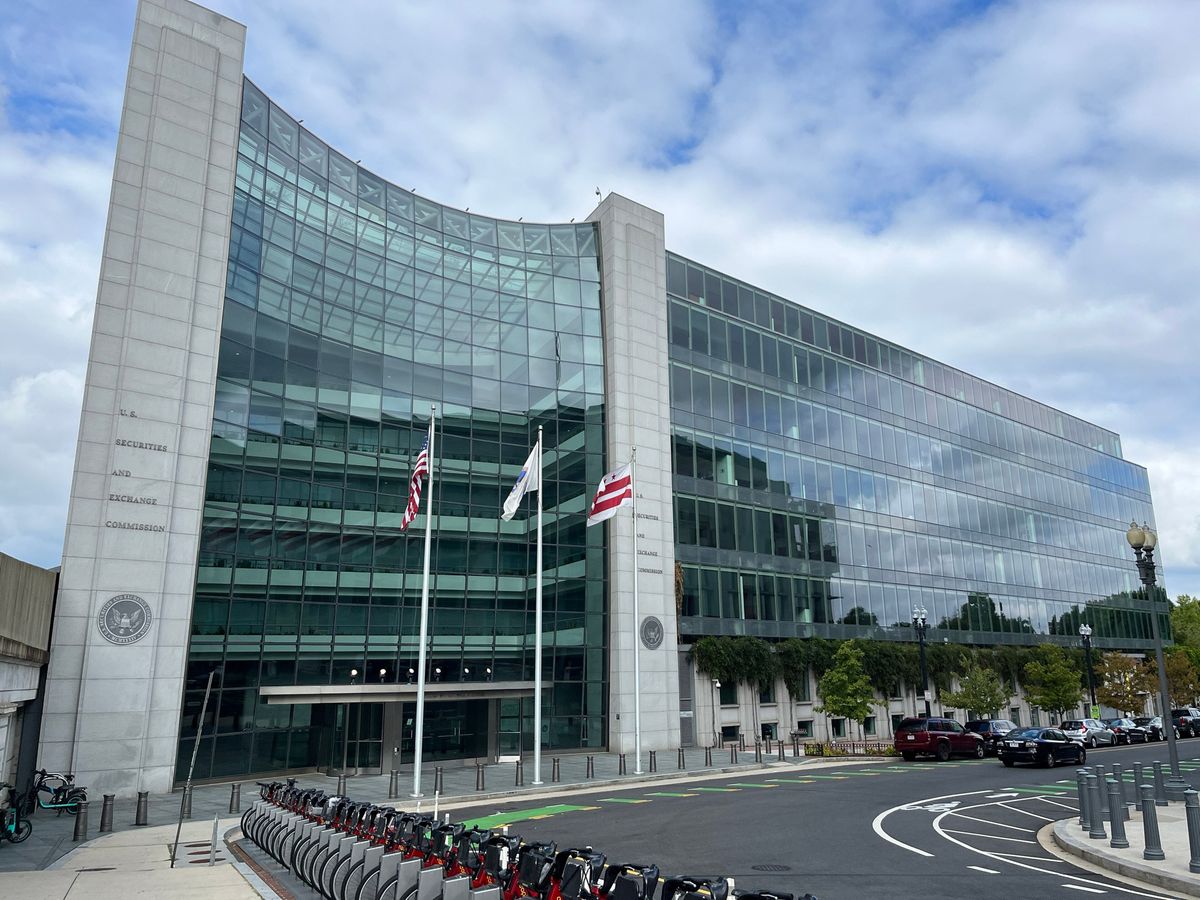
On May 26, 2021, Exxon Mobil held its annual meeting of shareholders, and partway through it had to stop. So many votes were still being cast that the meeting ran in two parts, with a recess of roughly an hour between them1. By the afternoon the oil company had lost at least two seats on its board to a hedge fund that had launched only months before. A week later Exxon said a third of the fund's nominees was expected to join the board as well2.

Quick Summary
The idea that environmental, social and governance risks belong in investment analysis was set out in a 2004 UN-backed report called Who Cares Wins5, which said this information is best conveyed through a company's normal investor relations channels4. Between 2020 and 2021 the idea went mainstream: BlackRock's Larry Fink told CEOs that climate risk is investment risk8, S&P 500 mentions of ESG on earnings calls peaked10, and Engine No. 1 won three Exxon board seats2 with a 0.02% stake1. The SEC adopted climate disclosure rules in March 202412. The retreat came fast. Vanguard13 and BlackRock15 left a net zero alliance for asset managers, Fink stopped using the term7, companies went quiet about their targets14, investors pulled money from US sustainable funds for three straight years17, and the SEC stopped defending its rule, leaving it on hold in court19,20. Even so, market gains lifted US sustainable fund assets to a record at the end of 202517. The lesson for investor relations: material risks explained in the language of long-term value outlasted every label put on them.
The fund was called Engine No. 1, and it owned 0.02% of Exxon1. It had sent its first letter to the board on December 7, 2020, and it spent about $30 million on the fight, against the $35 million Exxon expected to spend defending itself3. What carried the vote was the support of much larger holders: the California pension funds CalPERS and CalSTRS and the New York State Common Retirement Fund1, and BlackRock, which at the time managed $7.4 trillion3.
For a few years around that vote, environmental, social and governance issues looked like the new center of investor relations. Then the alliances broke up, the money left, and a federal rule that would have written climate risk into annual reports was stayed and then abandoned in court. This is the story of how ESG came into the investor relations office, why it retreated, and what a company that talks to its shareholders should take from both halves.
Fifty-five letters from the Secretary-General
In January 2004, United Nations Secretary-General Kofi Annan wrote to the chief executives of 55 of the world's leading financial institutions and invited them into a project4. He wanted guidelines on how to bring environmental, social and corporate governance issues into asset management, securities brokerage and research. The Swiss government paid for the work, and the UN Global Compact ran it4.
Eighteen institutions from nine countries, with more than $6 trillion under management, took part in writing the report, and twenty names appeared on its cover as endorsers, among them ABN Amro, AXA, BNP Paribas, Credit Suisse, Deutsche Bank, Goldman Sachs, HSBC, Morgan Stanley and UBS4. Its title was "Who Cares Wins: Connecting Financial Markets to a Changing World"4. The acronym ESG, which would later turn up on fund mandates and S&P 500 earnings calls, can be traced back to it5.
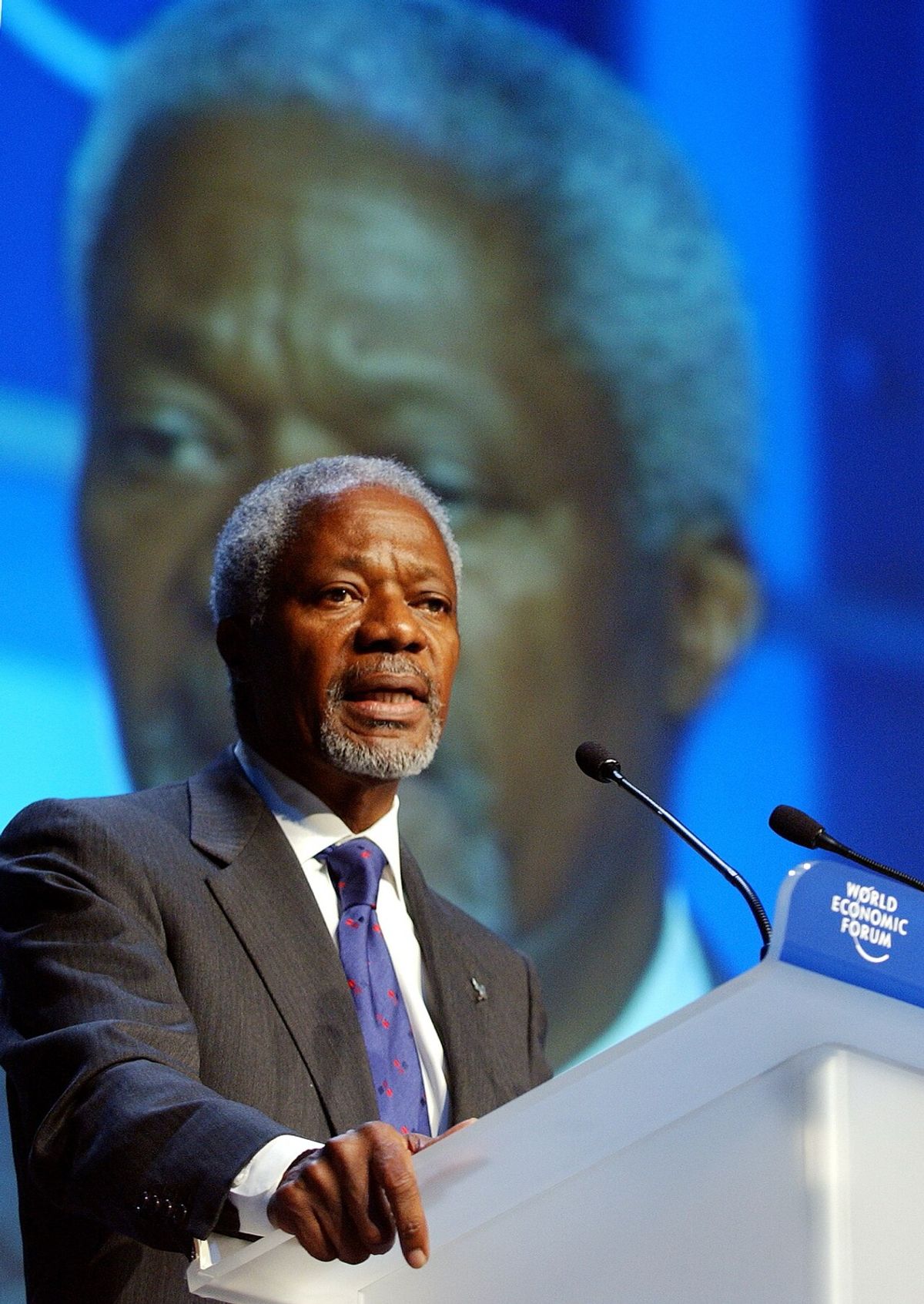
The report was presented at a press conference at UN Headquarters in New York on June 24, 2004, during the Global Compact Leaders Summit6. A reporter asked whether any of this was actually changing profit estimates or price targets. Anthony Ling, a managing director at Goldman Sachs, answered that in some high-profile energy cases it was, project by project, but that "everybody was distinctly hampered by the lack of objective, transparent information"6. The goal, in the UN's account of his remarks, was consistent data, so that these issues worked their way into valuations steadily, "rather than having a vacuum followed by an enormous explosion when something went wrong with the company"6.
That is an investor relations problem, and the report said so. Its recommendations for companies asked them to report on these issues "in a more consistent and standardised format," to identify the value drivers that mattered, and then to deliver the information to the market in a particular place: "We believe that this information is best conveyed to financial markets through normal investor relation communication channels and encourage, when relevant, an explicit mention in the annual report of companies"4. It also told companies that they "should accept positive as well as critical results" when analysts assessed them, and its endorsers planned to approach investor relations associations directly4.
The report leaned on a 2003 survey of European fund managers, analysts and investor relations officers by CSR Europe, Deloitte and Euronext. Seventy-eight percent of the fund managers and analysts said good management of environmental and social risk had a positive effect on a company's long-term market value. Over three to twelve months, only 32% thought it made a significant difference4. The gap between the long view and the short one runs through the rest of this story.
"Climate risk is investment risk"
The ideas in Who Cares Wins reached a far wider audience of chief executives in January 20207, through Larry Fink's annual letter to the CEOs of the companies BlackRock invests in8.
"Climate change has become a defining factor in companies' long-term prospects," Fink wrote, and "I believe we are on the edge of a fundamental reshaping of finance"8. He described clients asking how to change their portfolios and concluded that investors were "recognizing that climate risk is investment risk"8. The letter then turned into a set of requests that landed squarely on investor relations desks. BlackRock asked companies to publish, by the end of the year, disclosures in line with the Sustainability Accounting Standards Board's industry guidelines and to report climate risks under the recommendations of the Task Force on Climate-related Financial Disclosures8.

It came with a warning about votes. "Last year BlackRock voted against or withheld votes from 4,800 directors at 2,700 different companies," Fink wrote, and the firm would be "increasingly disposed to vote against management and board directors when companies are not making sufficient progress on sustainability-related disclosures"8. One sentence in the letter reads like a brief for every investor relations officer in the country: "In the absence of robust disclosures, investors, including BlackRock, will increasingly conclude that companies are not adequately managing risk"8.
Companies started saying the word out loud. FactSet searches the transcripts of S&P 500 earnings calls, and in the third quarter of 2020, 79 companies used the term "ESG," the highest number in at least eight years9. The count kept climbing until it peaked at 155 in the fourth quarter of 202110. Money moved the same way. US sustainable funds took in nearly $70 billion in 2021, a record and a 35% increase on 202011.
0.02% of Exxon
Engine No. 1 was launched in late 2020 by the tech investor Chris James and two other hedge fund veterans, and it described itself as "purpose-built to create long-term value by harnessing the power of capitalism"3. Its first campaign was against one of the largest energy companies in the world, a company worth nearly $250 billion3.
Exxon was a vulnerable target on the numbers. Its stock had been cut nearly in half since an all-time high above $100 in January 2014, and in 2020 it had been removed from the Dow Jones Industrial Average after nearly a century in the index1. Engine No. 1 nominated four independent directors, hoping to replace a third of the board, and asked for a review of Exxon's climate plan and its effect on the company's finances3. Two business-school scholars who followed the fight noted that its public case was mostly about shareholder value, with demands for a better long-term capital allocation strategy and a fix for "misaligned" management pay3.
Exxon moved while the fight was on. It proposed a $100 billion carbon capture project in Houston and committed $3 billion to low-emission technologies3. Two days before the vote it said in a filing that it would add two new directors over the next year, "one with energy industry experience and one with climate experience"1. Engine No. 1 replied that the board needed directors who could "turn aspirations of addressing the risks of climate change into a long-term business plan, not talking points"1.
On the day of the meeting, with the result on two seats clear and the third too close to call, Exxon's chief executive Darren Woods went on CNBC. "We're looking forward to welcoming the new directors," he said. "I look forward to helping them understand our plans and then hear their insights and perspectives"1. When the third seat was confirmed a week later, his statement used the language the activist had used all along: "We look forward to working with all of our directors to build on the progress we've made to grow long-term shareholder value and succeed in a lower-carbon future"2.
For investor relations, the Exxon vote was a lesson in who persuades whom. A fund with a tiny stake won because the largest holders were persuaded that the board had a long-term value problem, and because those holders had spent the previous two years being told, in letters like Fink's, that disclosure on these issues was part of how they judged management.
More than 24,000 comment letters
The next step was regulation. The Securities and Exchange Commission proposed climate disclosure rules in March 2022, received more than 24,000 comment letters, including more than 4,500 unique ones, and adopted final rules on March 6, 202412.
The SEC's chair, Gary Gensler, framed the rules as an old promise. "Our federal securities laws lay out a basic bargain," he said. "Investors get to decide which risks they want to take so long as companies raising money from the public make what President Franklin Roosevelt called 'complete and truthful disclosure'"12.

The rules would have required companies to disclose climate-related risks that had or were reasonably likely to have a material impact on their strategy, results or financial condition, along with board oversight of those risks and any climate targets that materially affected the business12. Large accelerated filers and accelerated filers would have reported material Scope 1 and Scope 2 greenhouse gas emissions, backed by an assurance report12. The costs of severe weather events, above a one percent threshold, would have gone into a note to the financial statements12.
For investor relations teams, the most consequential line may have been about location. Gensler said the rules would "require that climate risk disclosures be included in a company's SEC filings, such as annual reports and registration statements rather than on company websites, which will help make them more reliable"12. Twenty years after Who Cares Wins asked for "an explicit mention in the annual report"4, the US regulator had written that request into its rules. It would not stay there long.
Misused by the far left and the far right
The retreat had begun well before the rule was adopted. In December 2020, 30 asset managers with about $9 trillion under management launched the Net Zero Asset Managers initiative. By November 2022 it had nearly 300 members with $66 trillion13. On December 7, 2022, Vanguard, which had joined in March 2021 and managed more than $7 trillion, announced it was leaving13. It said it wanted "to make clear that Vanguard speaks independently on matters of importance to our investors"13.
The pressure behind that decision was political and it was public. Several Vanguard funds had appeared on a list of funds subject to potential divestment by the Texas comptroller, and Republican attorneys general had cited Vanguard's membership in a protest to federal energy regulators13. Utah's attorney general, Sean Reyes, welcomed the exit and called the alliance "a multi-national banking coalition whose mandates compromise fiduciary duties and minimize shareholder profits in exchange for a radical environmental agenda"13.
Companies started to go quiet. In October 2022, the climate consultancy South Pole surveyed the sustainability leads at more than 1,200 large companies with net zero targets and found that one in four of those with science-based targets did not plan to publicize them14. It called the practice "green-hushing" and described companies "going green and then going dark"14. "This is impossible if progress is happening in silence," said South Pole's chief executive, Renat Heuberger, of the hope that leaders would pull their peers along14.
At the Aspen Ideas Festival in June 2023, the man most identified with ESG backed away from the word. "I'm ashamed of being part of this conversation," Larry Fink said, before walking the comment back later in the same session7. "When I write these letters, it was never meant to be a political statement," he said. "I'm not going to use the word ESG because it's been misused by the far left and the far right"7. By then Texas had accused BlackRock of boycotting fossil fuel companies, and Florida had threatened to withdraw $2 billion of treasury funds from the firm7.
Earnings calls followed. In the fourth quarter of 2023, only 29 S&P 500 companies said "ESG" on their calls, the lowest number since the second quarter of 2019 and far below the five-year average of 8210.
In January 2025, BlackRock left the Net Zero Asset Managers initiative too15. Its letter to clients said that many of its largest clients, "including 100% of our largest client relationships in Europe," had made net zero commitments, but that its memberships "have caused confusion regarding BlackRock's practices and subjected us to legal inquiries from various public officials"16. With BlackRock gone, State Street was the last of the three largest US asset managers still in the alliance15.
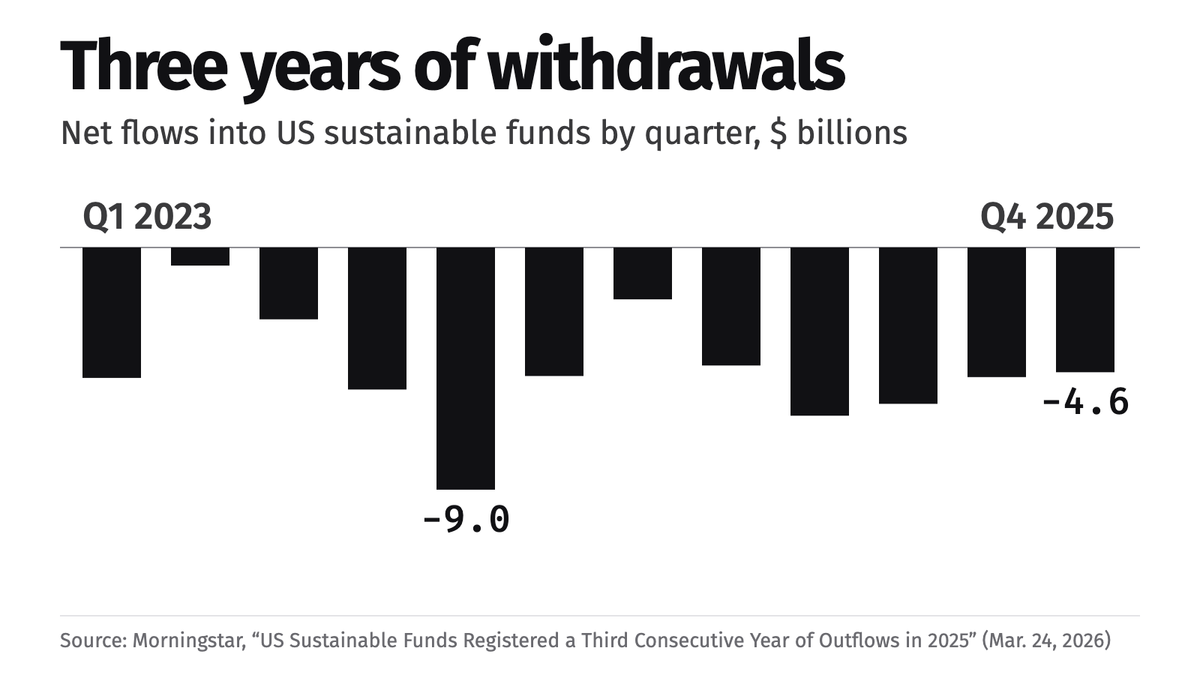
The money told the same story. Morningstar's quarterly figures show investors pulling money out of US sustainable funds in every quarter from the start of 2023 to the end of 2025: $13.4 billion in 2023 and just under $20 billion in 202417, while conventional funds took in about $740 billion in 202418. Parnassus and BlackRock had the largest redemptions that year, and for the first time more sustainable funds closed or dropped their ESG mandates than launched: 10 new funds against 71 merged or liquidated and 24 that dropped the mandate18. In 2025 investors pulled about $21 billion more, the third straight year of outflows and the worst year since Morningstar began keeping track more than a decade ago17.
"Costly and unnecessarily intrusive"
The SEC's climate rules never got to work. States and private parties challenged them, the cases were consolidated in the US Court of Appeals for the Eighth Circuit, and in April 2024, weeks after adopting the rules, the Commission stayed them until the litigation was over19,20.
Then the administration changed. On March 27, 2025, the Commission voted to stop defending the rules. "The goal of today's Commission action and notification to the court is to cease the Commission's involvement in the defense of the costly and unnecessarily intrusive climate change disclosure rules," said the acting chairman, Mark Uyeda19. SEC staff told the court that Commission counsel were no longer authorized to advance the arguments in the brief it had already filed19.
That left a rule with nobody defending it and nobody repealing it. In July 2025 the SEC told the court it did not intend to revisit the rules and asked for the case to proceed20. On September 12, 2025, the Eighth Circuit declined20. It kept the case on hold until the SEC either reconsidered the rules through notice-and-comment rulemaking or decided to renew its defense, saying it was the agency's job to decide whether to rescind, repeal, modify or defend them20.
"Dominated by one fund"
The retreat left a strange picture at the end of 2025. Investors withdrew about $4.6 billion from US sustainable funds in the fourth quarter alone17. Yet market gains lifted the category's total assets to a record $368 billion at the end of December, above the previous peak set in 202117.
The money that did come in was concentrated. Morningstar said 2025, and especially its fourth quarter, were "dominated by one fund": First Trust Nasdaq Clean Edge Smart Grid Infrastructure Index ETF, which tracks companies that develop electric grid infrastructure, energy storage and related software17. It collected $1.3 billion in the fourth quarter and more than $2.5 billion over the year17. Morningstar credited the surge in the use of artificial intelligence, and the electricity it consumes, with lifting flows into some clean energy funds17.
What money did come in went to grids and storage. It looked more like what Anthony Ling had described in 2004, these issues working their way into valuations case by case6, than like the wave of 2021.
What twenty years of ESG teach an investor relations team
Make the case in the language of long-term value. Who Cares Wins argued in 2004 that companies managing these issues well could increase shareholder value4. Engine No. 1 won at Exxon by arguing about capital allocation and long-term value3, and Exxon's own statement afterwards spoke of "long-term shareholder value"2. The argument that held up through every change of name was about value.
Put material facts where investors already look. The 2004 report wanted these disclosures in "normal investor relation communication channels" and the annual report4. Gensler wanted them in SEC filings rather than on company websites12. Whatever becomes of the rule, a risk that can move the business belongs in the same documents, on the same calls and in the same language as revenue and margins.
Silence is also a disclosure. One in four companies with science-based targets chose not to talk about them14. Fink's 2020 warning cuts both ways: in the absence of robust disclosures, investors conclude that risks are not being managed8. Going quiet protects a company from one kind of criticism and invites another.
Every public commitment will be tested. Vanguard said its alliance membership had caused confusion about its views13. BlackRock said its memberships had brought legal inquiries from public officials16. A pledge made in a good year gets read aloud in a bad one, so investor relations teams should commit only to what the business can explain and defend in both.
Plan for the pendulum. Seventy-nine S&P 500 companies said "ESG" on earnings calls in the third quarter of 20209, 155 at the peak, and 29 by the end of 202310. US sustainable funds went from nearly $70 billion of inflows in 202111 to three years of outflows, even as their assets climbed to a record17. A message built for the mood of one year has to survive the next.
In May 2021, Exxon's shareholders needed an extra hour to finish voting1. On ESG, the market has needed nearly five more years, and the count is still going. The companies that come through it well will be the ones that kept explaining their material risks to investors in plain terms the whole time, through the normal investor relations channels a UN report pointed to in 2004.
Sources
- 1
- 2
- 3
- 4
- 5
- 6
- 7
- 8
- 9
- 10
- 11
-
12
SEC Adopts Rules to Enhance and Standardize Climate-Related Disclosures for Investors, press release 2024-31, Mar 6, 2024
- 13
- 14
- 15
- 16
- 17
- 18
-
19
SEC Votes to End Defense of Climate Disclosure Rules, press release 2025-58, Mar 27, 2025
- 20
-
Header image

The AMW® Editorial Team covers marketing, business growth and the software AMW builds for businesses.
Related Resources
Calculators
Case Studies
Related Articles

Howard Schultz and the Starbucks Third Place Strategy
Howard Schultz built Starbucks around a room people wanted to stay in. Seventy percent of orders now skip that room. What changed, and what it means for service firms.

How Phil Knight Sold Shoes From a Car Trunk to Build Nike
In 1964 Phil Knight sold Onitsuka Tigers from his car at Pacific Northwest track meets. Here is what that trunk did for Nike, and which parts still apply now that outreach is cheap.

TechCrunch Disrupt 2026: A Plan If You're Not Raising
Going to TechCrunch Disrupt 2026 without a pitch deck? Use this working plan to turn one week in San Francisco into customers, partners, hires and market intel.