

How to Run a Successful Non-Deal Roadshow: What the SEC Cases and the Research Teach

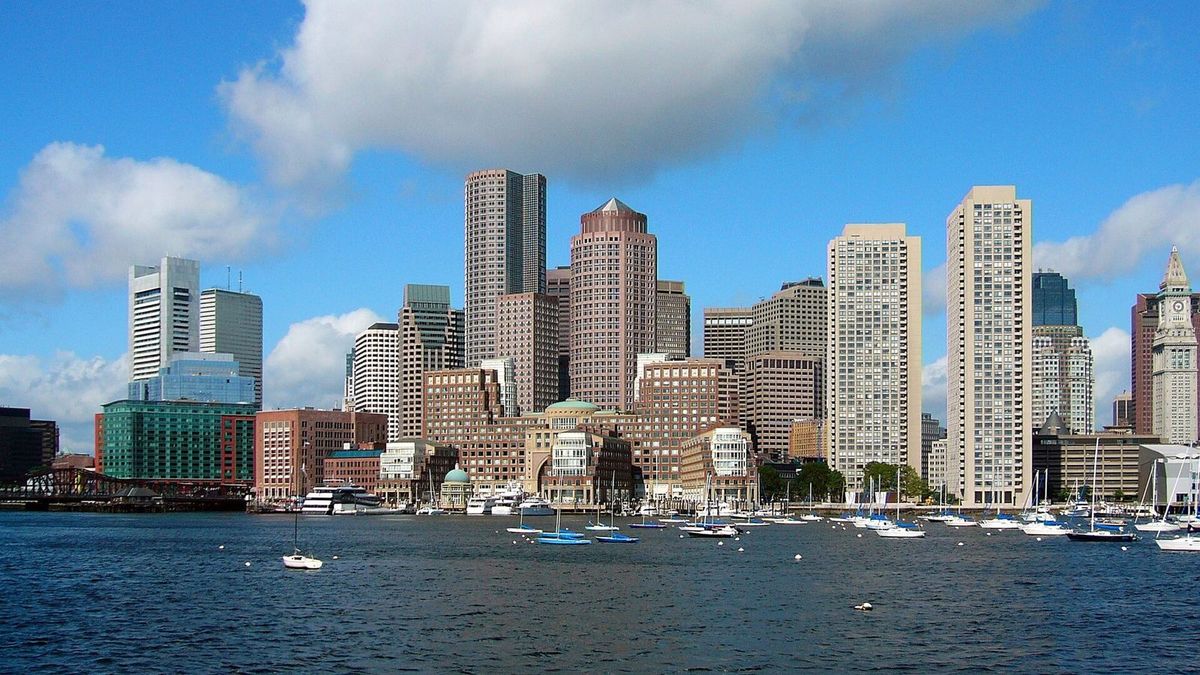
At about six in the evening on April 30, 2003, Siebel Systems' chief financial officer, Kenneth Goldman, sat down to dinner in Morgan Stanley's New York offices with roughly six institutional investors1. It was the last stop of a three-day marketing trip. He and the company's head of investor relations, Mark Hanson, had started at a Deutsche Bank conference in New York on April 28, held one-on-one meetings with large investors in Boston the next day, and come back to New York for three more meetings and the dinner1. Over the meal, Goldman said the company's business activity levels were "good" or "better" and that its sales pipeline was "building"1.

Quick Summary
A non-deal roadshow is a series of private meetings, often arranged by a broker, in which management visits investors at their offices3. Since October 23, 2000 those meetings have run under Regulation FD, which requires a company that gives market professionals or likely traders material nonpublic information to make it public5. The SEC's cases show where roadshows go wrong: Flowserve's CEO reaffirmed earnings guidance to four analysts in a private meeting7, Siebel's CFO described business privately in more upbeat terms than the company had in public1, and AT&T's investor relations team made private calls that produced what was then the largest Regulation FD penalty on record, $6.25 million17. Research that recorded the questions from 66 private interactions found that most meetings include at least one question asking for more timely information than the public record holds3. The companies that handle this best publish first: Casey's General Stores put a quarter-to-date business update in an 8-K before its 2023 non-deal roadshow13. Plan the itinerary around the right investors, put anything new on EDGAR before the first meeting, prepare for the timely question, and keep a record of what was said.
By 6:50 the next morning a Morgan Stanley sales trader was on the phone to a client. The analyst's take, he said, was that "the body language was positive"1. Morgan Stanley e-mailed the comments to hundreds of people, the stock closed about 8% higher on nearly double its usual volume, and Hanson, checking his e-mail at San Francisco airport, found a message quoting a news service: "SEBL higher on chatter of CFO speaking positively on business conditions at an event last night"1. The SEC later took Siebel to court over that dinner and the meeting before it2.
A non-deal roadshow, when executives travel to meet investors with no securities offering on the table, is the most private conversation a public company has with the market. Done well it builds an investor base. Done carelessly it produces an 8-K filed after the stock has already moved, and an enforcement release. This guide draws on the SEC's case files, the filings of companies that run roadshows in the open, and a decade of research on what actually happens in the room, to answer one question: how do you run a roadshow that investors value and that would stand up if a regulator read the notes?
A three-day marketing trip
The SEC's complaint describes Siebel's April 2003 trip as a "marketing" effort, and that is an honest word for what a roadshow is1. Management leaves headquarters, and for a few days the company's story is told in person, one investor at a time. The researchers Jihwon Park and Eugene Soltes, who studied a Nasdaq-listed biotechnology company's meetings in 2016, describe non-deal roadshows as the venue "where the executives travel to the investors' offices," as distinct from meetings at industry conferences or on the phone3.
The time involved is real. Park and Soltes cite industry surveys finding that the average firm held 114 one-on-one meetings with investors in 2015, and that managers at the average North American firm spent 14 days that year on the road meeting investors3. They also cite a Thomson Reuters survey reporting that 97% of CEOs of publicly traded firms meet privately with investors3. Roadshow meetings also run long. At the biotech company, they ran an hour on average, compared with 30 minutes for meetings at conferences3.
Most of these meetings are arranged by someone other than the company. Park and Soltes write that they are "often arranged and paid for by sell-side analysts who offer such meetings to brokerage clients who trade through their firms"3. The Wharton accounting professor Brian Bushee, who has studied broker-hosted access for years, put the economics plainly: "Buy side investors say about a quarter of the commissions they pay for their trading is to compensate analysts for giving them access to management"4. That is worth remembering when a broker proposes an itinerary. The broker's best clients and the company's best prospective holders can be different lists.
The rule that changed the room
Regulation FD was adopted on August 15, 2000 and took effect on October 23 of that year5. The SEC's proposal had drawn nearly 6,000 comment letters, most of them from individual investors5. The adopting release explained the harm in one sentence that every roadshow planner should know: when companies disclose selectively, "a privileged few gain an informational edge," and the ability to profit from it, "from their superior access to corporate insiders, rather than from their skill, acumen, or diligence"5.
The rule allows private meetings. It requires that when a company discloses material nonpublic information to market professionals or to holders who may trade on it, the company must make that information public, at the same time if the disclosure is intentional and promptly if it is not5. The release singled out one situation that "raises special concerns": an analyst asking for "guidance" about earnings. If an official signals that earnings will be "higher than, lower than, or even the same as what analysts have been forecasting," the release says, the company "likely will have violated Regulation FD"5.
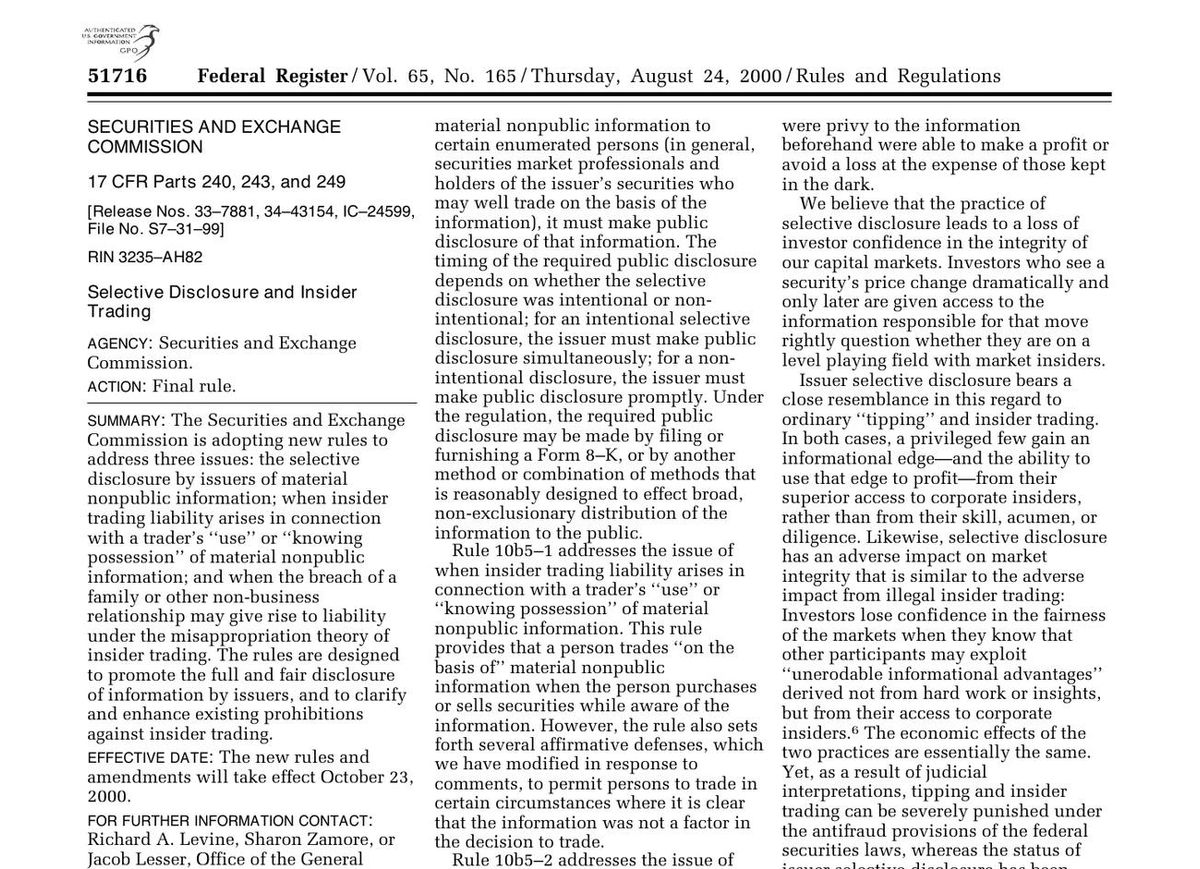
The same release left room for the ordinary business of a meeting. A company may share a non-material detail even if, "unbeknownst to the issuer," it helps an analyst complete a "mosaic" of information that is material when put together5. That distinction is the whole art of a roadshow. Management can explain strategy, walk through public numbers and describe how the business works in more depth than a conference call allows. The line falls at handing one room the piece that moves the stock.
The first enforcement actions came on November 25, 2002, against Raytheon, Secure Computing and Siebel, together with a report on Motorola6. Siebel's case arose from remarks Thomas Siebel had made at an invitation-only Goldman Sachs conference in 2001, and the company paid a $250,000 penalty1. Six months later came the April 2003 trip2.
"Reaffirmed"
Flowserve's case shows how little it can take. On November 18 and 19, 2002, the maker of flow control equipment hosted a two-day private analyst event at its headquarters in Irving, Texas, attended by analysts from four firms7. On the morning of the 19th, forty-two days before the end of the fiscal year, an analyst asked about earnings guidance, and the chief executive, C. Scott Greer, "reaffirmed the previous guidance" of $1.45 to $1.55 a share that the company had issued on October 227. Nothing about the guidance had changed. The reaffirmation was the news.
One analyst put it second among five "Key Points" in a report the next day7. On November 21 the stock closed about 6% higher and volume rose 75%, from 379,500 shares to 658,3007. Flowserve filed an 8-K after the close that day, at 5:16:43 p.m., which the SEC calculated was "more than 53 hours after the actual selective disclosure"7. The company paid a $350,000 penalty and Greer paid $50,000, and the company, Greer and its director of investor relations agreed to an administrative order8.
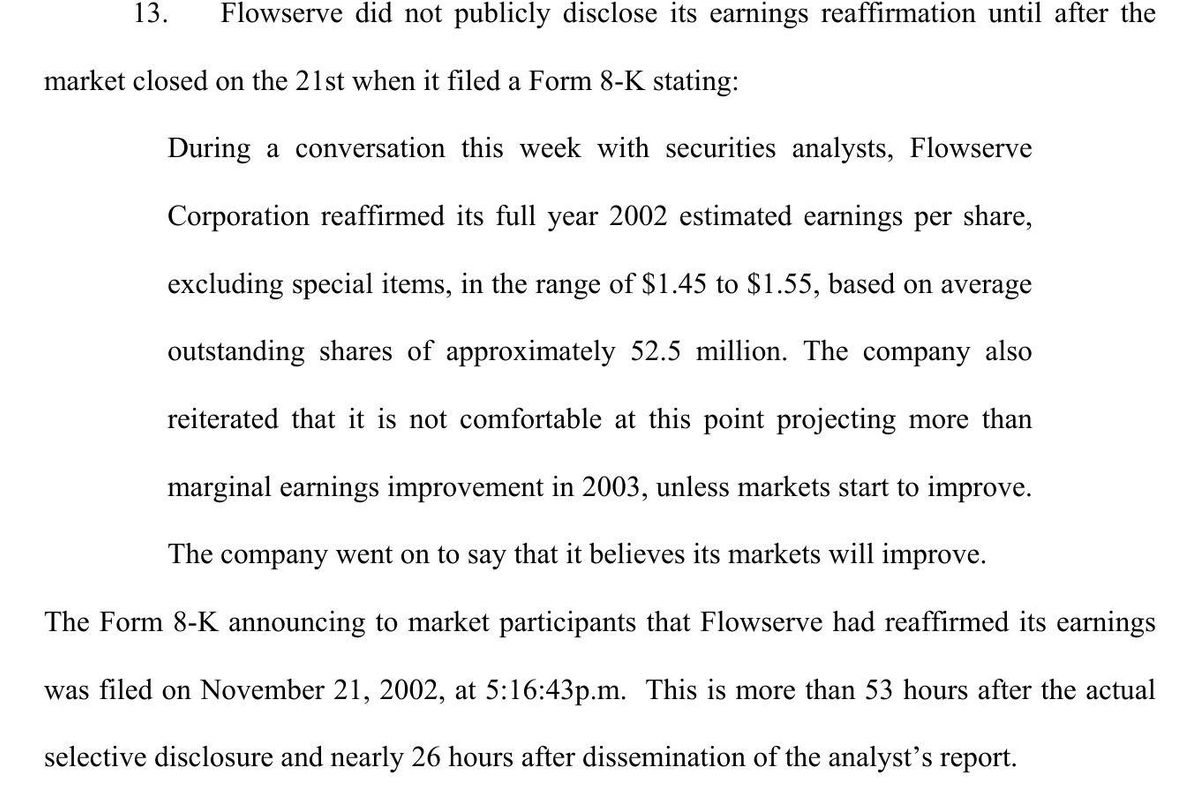
Once the 8-K was out, the stock stopped moving. The next day the stock closed at $14.30, the same as the day before, and volume fell by nearly 25%7. The news had been the reaffirmation itself, and for more than two days it belonged to the analysts in that room and the readers of one report.
The SEC staff's published interpretations explain the logic. Whether a private confirmation is material depends on what it adds, including "the amount of time that has elapsed between the original forecast and the confirmation"; a confirmation near the end of a quarter "might convey information about how the issuer actually performed"9. Saying a company is "still comfortable with" a forecast counts as confirming it9. The staff also offers the answer that keeps a roadshow meeting safe: "If, when asked about a prior forecast, the issuer does not want to confirm it, the issuer may simply wish to say 'no comment'"9.
"Fair accuracy, not perfection"
Siebel fought its second case and won. In September 2005 Judge George B. Daniels of the Southern District of New York dismissed it, ruling that Goldman's statements "did not add, contradict, or significantly alter the material information available to the general public"10. He criticized the SEC for having "scrutinized, at an extremely heightened level, every particular word used in the statement, including the tense of verbs and the general syntax of each sentence"10. "Regulation FD does not require that corporate officials only utter verbatim statements that were previously publicly made," he wrote. "Fair accuracy, not perfection, is the appropriate standard"10.
The ruling is a comfort to anyone who has to talk to investors for a living, and it is also a lesson in how close Siebel came. The complaint showed that after the first case, Hanson's written objectives for 2003 weighted "fully comply with Regulation FD" at 10%, behind upgraded analyst ratings at 30% and getting institutions to "significantly increase their holdings" at 30%1. The company had not recorded what Goldman said at either event1. When the stock moved, Hanson told the general counsel the rumors were false, and Goldman wrote that he had "only reiterated exactly what was stated at the earnings call"1. The company won on the words. It had no notes of its own to show them.
What investors ask when the door closes
For most of Regulation FD's life, researchers knew when these meetings happened and very little about what was said in them. Park and Soltes found out by embedding a research associate with more than a decade of investor relations experience inside two public companies3. The associate sat "immediately behind the firm executives" and was introduced, if anyone asked, as someone helping management understand the effectiveness of its meeting practices3. To protect the executives, only the questions were recorded, never the answers3.
Over nine months of 2016 the biotech company held 71 private interactions, including 17 roadshow meetings at investors' offices, and the study classified 949 questions from 66 of them3. Most, 77%, asked for more depth on information already public: "Was the product manufactured from the same lot as for the trials?"3. Nine percent were what the authors call proprietary questions, where an investor tests a thesis without revealing it on a public call: "What looks more attractive right now: M&A activity or share buybacks?"3. Smaller groups asked about management philosophy ("What keeps you up at night?") and about facts an investor could have looked up ("Who are your largest shareholders?")3.
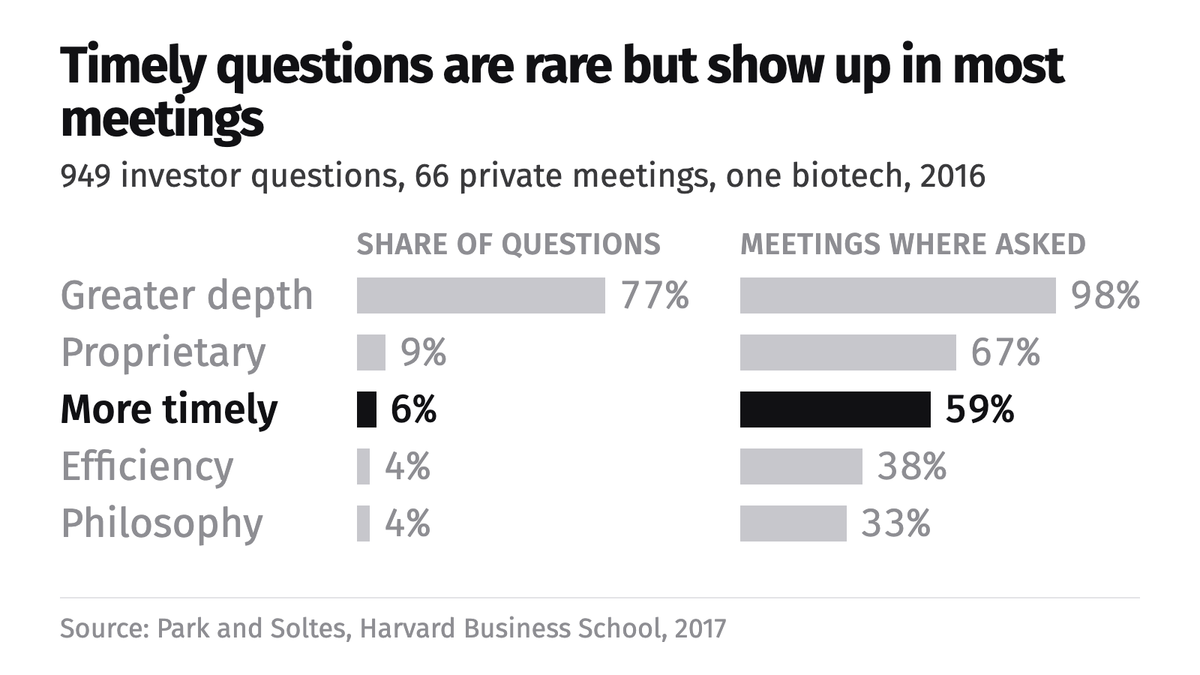
The category that matters most for compliance is the smallest. Questions seeking more timely information than the public record made up only 6% of all questions, yet 59% of meetings included at least one3. The examples read like a roadshow compliance checklist: "How much cash do you have now?" and "Are the Q2 earnings call expectations still valid?"3. The authors single out timely questions as the ones that "appear to pose the greatest regulatory risk," and they counted 26 different investors who asked the biotech company for a more recent cash figure3. They also found that questions asked in private were "shorter and more negative" than those asked on public conference calls3.
That gives a practical rule for preparation. Management should expect the timely question in most meetings and agree before the trip on the answer, which is the last public number and its date. When the same question keeps coming, the authors raise the question of whether the company should publish that figure more often3.
Who gets the meeting
A roadshow has a limited number of hours, and choosing who fills them is the first real decision. A survey of 610 investor relations officers by Lawrence Brown, Andrew Call, Michael Clement and Nathan Sharp found that IROs act as "the primary gatekeepers who control access to senior management," and that they are more likely to grant access to analysts with a long history of covering the company and to investors at large investment firms than to hedge funds11. The biotech company in the Park and Soltes study tried to accommodate every request but gave preference in timing and venue "to larger institutional investors who are long-term holders or potential buyers," and was less inclined to visit a hedge fund on a roadshow than an investment adviser3. Most of its private meetings were with investors who did not own the stock3.
The research suggests those preferences have consequences. David Solomon and Eugene Soltes studied six years of a mid-cap insurance company's private meetings3 and found that investors who met management made "more informed trades by increasing the size of their position before periods of high returns and reducing their position before periods of low returns," with the effect concentrated among hedge funds12.
On the question of virtual meetings, Bushee recalled that after September 11, 2001, when travel was cut back, virtual investor conferences briefly took hold and then "died off almost immediately," because "it's about being there and having those personal interactions"4. The same survey of IROs found that companies rank road shows among the most important ways to convey their story, alongside earnings calls and press releases11.
Say it in public first
The companies that run roadshows with the least risk make the public record complete before the plane leaves. On January 31, 2023, Casey's General Stores issued a business update "in advance of its participation in a 'non-deal' roadshow"13. It told the market that third-quarter-to-date performance "remains consistent with our expectations for the full year," that same-store inside sales were "in the lower half of our annual range of a 5-7% increase," and that fuel gallons were "near the low end of the annual range"13. It also disclosed a one-time payment of about $15 million from resolving legal matters that had not been in its earlier expense guidance13.
That release answers the Flowserve problem. The quarter-to-date picture, the very thing an investor asks for in a timely question, was public before anyone could ask for it in private. Fifth Third Bancorp takes a lighter version of the same approach, furnishing the presentation its executives would use "during a February 2024 non-deal roadshow"14, so that the slides in the room are the slides on EDGAR.
The SEC staff's interpretations make the timing simple. A company that has filed or furnished information need only confirm that the filing "has been accepted for filing on EDGAR and is publicly available on EDGAR" before discussing it in a private meeting9. The meeting can follow at once. Improvisation gets less room: if a CEO decides mid-meeting to share something she knows is material and nonpublic, the staff treats it as an intentional disclosure "even though she did not originally plan to make it"9.
The part nobody announces
An honest guide has to include the criticism of the practice itself. Roadshows are mostly invisible to the investors who are not invited. Bushee, Joseph Gerakos and Lian Fen Lee identified them by tracking roughly 400,000 corporate jet flights, defining a roadshow as a three-day window with flights to money centers and to cities where a company had high institutional ownership15. Those trips showed "greater abnormal stock reactions, analyst forecast activity, and absolute changes in local institutional ownership than other flight activity," and, in firms with more complex information and infrequent private meetings, trading gains that suggest "roadshows provide participating investors an advantage over non-participating investors"15.
Solomon and Soltes drew a similar conclusion from their meeting logs: permitting private meetings "undermines regulators' objective of wanting all investors to have equal access to information," even when no rule is broken, because a sophisticated investor can combine a small detail with everything else it knows12. Bushee described that effect with an example about tuna swimming lower in the water: an ordinary investor could do nothing with the remark, "But if I'm one of the big investors... It's as if I have been missing just one piece of the puzzle"4. His judgment on the system after Regulation FD: "It still seems bad, but not as bad as it was before Reg FD was passed, when access got you the answer as opposed to a piece of the puzzle"4.
The enforcement record shows the temptation persists. In 2007 Office Depot's investor relations staff made one-on-one calls, prepared with the help of the CFO, that steered analysts toward lower estimates by pointing to comparable companies' public statements; the company paid $1 million16. In 2016 AT&T's investor relations executives made private calls to analysts at about 20 firms that led them to cut their revenue forecasts, and in December 2022 AT&T agreed to pay $6.25 million, at the time the largest Regulation FD penalty ever, while three executives paid $25,000 each17. Both were private phone calls, run for the purpose of moving expectations.
The lessons for running a roadshow
Plan the itinerary around the holders you want. Brokers often arrange the meetings3, and their incentives come from trading commissions4. Give preference, as IROs report doing, to long-term institutions and to prospective holders who fit the story11.
Put anything new on EDGAR before the first meeting. If management will affirm guidance or update the quarter, say so in an 8-K or press release first, as Casey's General Stores did13. Once the filing is accepted and publicly available, it can be discussed in private9.
Prepare the timely question. Most meetings will include a request for more current numbers than the public record holds3. Agree the answer in advance: the last public figure, with its date, or "no comment"9.
Treat a reaffirmation as news. Flowserve's CEO repeated guidance that was already public and still paid a penalty8. The SEC staff explains why: a confirmation late in a period can say how the business actually performed9.
Keep notes of every meeting. Siebel had no record of what its CFO said1. A note-taker protects the company twice: it shows what was said, and it is the fastest way to decide whether a same-day disclosure is needed.
Make compliance a goal that counts. Siebel's IR head was measured 30% on analyst upgrades and 10% on following the rule1. Weigh the rule in the IR team's goals as heavily as the results it is asked to deliver.
Say in private what you would be comfortable seeing in the morning e-mail. The Siebel dinner was on the phone to a client by 6:50 the next morning and in e-mails to hundreds of people1. Plan every meeting on the assumption that it will be.
Sources
- 1
- 2
- 3
- 4
- 5
- 6
- 7
- 8
- 9
- 10
- 11
- 12
- 13
- 14
- 15
- 16
- 17

The AMW® Editorial Team covers marketing, business growth and the software AMW builds for businesses.
Frequently Asked Questions
What is a non-deal roadshow?
A series of private meetings in which a public company's executives travel to investors' offices when no securities offering is under way. Brokers often arrange the meetings for clients who trade through them.
Does Regulation FD ban one-on-one meetings with investors?
Regulation FD allows private meetings. It requires that if a company discloses material nonpublic information to market professionals or holders likely to trade on it, the company makes that information public, at the same time if the disclosure is intentional and promptly if it is not.
Can management reaffirm guidance during a roadshow?
Only with care. The SEC charged Flowserve after its CEO privately reaffirmed earnings guidance to analysts in 2002. SEC staff guidance says a private confirmation can be material, especially late in a period, and that an executive may simply say "no comment." Companies such as Casey's General Stores have instead put a quarter-to-date business update in an 8-K before their roadshow meetings.
What do investors ask in private meetings?
In a study of 949 questions from 66 private meetings with a biotech company, 77% sought more depth on public information. Questions asking for more timely information were only 6% of the total but came up in 59% of meetings.
Related Resources
Calculators
Case Studies
Related Articles

Howard Schultz and the Starbucks Third Place Strategy
Howard Schultz built Starbucks around a room people wanted to stay in. Seventy percent of orders now skip that room. What changed, and what it means for service firms.

How Phil Knight Sold Shoes From a Car Trunk to Build Nike
In 1964 Phil Knight sold Onitsuka Tigers from his car at Pacific Northwest track meets. Here is what that trunk did for Nike, and which parts still apply now that outreach is cheap.

TechCrunch Disrupt 2026: A Plan If You're Not Raising
Going to TechCrunch Disrupt 2026 without a pitch deck? Use this working plan to turn one week in San Francisco into customers, partners, hires and market intel.