

How Investor Relations Impacts Stock Valuation: Buffett's Warning and the Evidence Behind It


On May 8, 1996, Berkshire Hathaway put its name to a prospectus for a new class of stock, and on its cover page, just below the share price, it told investors not to get excited. Berkshire's Class A shares had closed at $33,400 that day1. Then, in capital letters, came a message from the chairman and vice chairman, who urged readers to ignore anyone telling them that what followed was "boilerplate" or unimportant1. The first point read: "Mr. Buffett and Mr. Munger believe that Berkshire's Class A Common Stock is not undervalued at the market price stated above. Neither Mr. Buffett nor Mr. Munger would currently buy Berkshire shares at that price, nor would they recommend that their families or friends do so"1.

Quick Summary
Berkshire Hathaway's 1996 Class B prospectus warned buyers that its stock was fully priced, because Buffett wanted shareholders who understood the business and a share price that tracked its value1,3,2. The profession of investor relations began at General Electric in 1953, and in 2003 its trade body defined the goal as helping a company's securities achieve "fair valuation"4. The best evidence that information moves prices comes from a natural experiment: when brokerage firms shut their research departments between 2000 and 2005, the stocks they stopped covering fell, and those left with no analysts fell hardest6. Small companies that hired IR firms or built in-house IR teams gained analyst following, institutional owners, liquidity and valuation compared with matched peers7,8,9, and firms with better-rated IR programs trade at higher multiples5. The limits are real: paying for coverage that looks independent is fraud11, and stopping communication tends to go with trouble and a worse information environment12. The lesson for any public company is that investor relations earns its value by narrowing the gap between what a business is worth and what investors know about it.
It is a strange thing to read in a document written to sell shares. Warren Buffett put it there because of a view of investor relations he had held for years: what a company says to the market, and the kind of owner it sets out to attract, changes the price of its shares. He wanted that price close to what the business was worth, and he was as bothered by a stock trading too high as by one trading too low2. The research that has piled up since then asks the same question from the other side. Does investor relations change what a company's stock is worth? The answer turns out to be yes, for reasons that have little to do with spin.
"Whatever can be sold will be sold"
The offering existed because of a threat. Promoters unconnected to Berkshire were preparing unit investment trusts that would hold only Berkshire stock and market themselves as "miniature" Berkshires, with a way in for as little as $1,000, when a single Berkshire share cost about thirty times that1. Buffett explained the danger in his next letter to shareholders. The trusts, he wrote, "would have used our past, and definitely nonrepeatable, record to entice naive small investors and would have charged these innocents high fees and commissions"3. He expected them to sell billions of dollars' worth of units, and added: "In the securities business, whatever can be sold will be sold"3.
The trusts would then have poured that money into a fixed supply of Berkshire shares. "The likely result: a speculative bubble in our stock," Buffett wrote3. Shareholders who sold into it would have done well. Those who stayed would have been left, once reality set in, with "hundreds of thousands of unhappy, indirect owners" and "a stained reputation"3. The prospectus put the same point in terms of a business Berkshire owned: just as See's Candies would be harmed if poor-quality candy bearing its label were sold by others, Berkshire believed its reputation would be harmed by the trusts1.
So Berkshire built a stock designed to be bought by the right people. Each Class B share carried one-thirtieth of the economic interest of a Class A share and was priced at $1,1101. The underwriting discount was $16.65 a share, 1.5 percent, which Buffett called "the lowest payoff that we have ever seen in a common stock underwriting," chosen to blunt the enthusiasm brokers normally have for pushing new issues1,3. The size of the offering was left open-ended, "thereby repelling the typical IPO buyer who looks for a short-term price spurt arising from a combination of hype and scarcity"3. Berkshire sold 517,500 shares for net proceeds of $565 million. Trading in the new shares right after the offering, which Buffett treated as a rough measure of flipping, was far below the norm for a new issue, and the company added about 40,000 shareholders3.
"A narrow range centered at intrinsic business value"
The 1996 warning applied a policy Buffett had put in writing eight years earlier. Berkshire's shares were listed on the New York Stock Exchange on November 29, 1988, and in that year's letter he set out two ways in which his goals "probably differ somewhat from those of most listed companies"2. The first was price. "We do not want to maximize the price at which Berkshire shares trade," he wrote. "We wish instead for them to trade in a narrow range centered at intrinsic business value"2. Charlie Munger and he, he said, were "bothered as much by significant overvaluation as significant undervaluation"2.
The second was turnover. Berkshire wanted "very little trading activity" and owners who, "at the time of purchase, have no timetable or price target for sale but plan instead to stay with us indefinitely"2. He described how he meant to find them. "We try, through our policies, performance, and communications, to attract new shareholders who understand our operations, share our time horizons, and measure us as we measure ourselves"2. That is a description of an investor relations program, written by the chairman himself in his annual letter.

By the time of the 1996 letter the policy had been tested in public. The year before, with the shares at $36,000, Buffett had told shareholders that Berkshire's market value had outrun its intrinsic value and that he and Munger did not then consider the stock undervalued3. Over 1996, the business grew sharply while the share price "changed little," which, in his words, "means that in 1996 Berkshire's stock underperformed the business"3. He called the new relationship between price and value "more appropriate." "In a public company, fairness prevails when market price and intrinsic value are in sync," he wrote, and a manager "by his policies and communications" can "do much to foster equity"3.
A job with a name since 1953
Buffett's view sounds like common sense now, and it is close to the official definition of the profession. Investor relations as a corporate function dates to 1953, when Ralph Cordiner, chairman of General Electric, created a department in charge of all shareholder communications4. The postwar boom had put spare income into American households, and companies found themselves competing for it, so they turned first to their public relations staff4. According to a history of the field published by the Institute for Public Relations, the work shifted over the following decades from mass communication with small shareholders toward one-on-one meetings with institutional investors and analysts, run under the chief financial officer4.
In March 2003 the National Investor Relations Institute adopted a definition that reads like a summary of the Berkshire letters. Investor relations, it says, is "a strategic management responsibility that integrates finance, communication, marketing and securities law compliance to enable the most effective two-way communication between a company, the financial community, and other constituencies, which ultimately contributes to a company's securities achieving fair valuation"4. The earlier version, adopted in 1996, had called it "a marketing activity"4.
Fair valuation is a big claim for a department that mostly answers questions. Classical finance offers a reason to doubt it. If markets already price in all public information, then, as one group of researchers put it, "'repackaging' and communicating existing information should have no market impact"5. Measuring the effect is hard. A company's information environment and its share price can both be driven by other things, and the causation can run backward6. The cleanest answer came from an accident of the brokerage business.
When the analysts went away
Between 2000 and 2005, the brokerage industry went through a slump. Trading volumes fell in the bear market, competition for order flow cut revenue, and regulators revisited how research could be paid for with soft dollars6. Two New York University finance researchers, Bryan Kelly and Alexander Ljungqvist, used press reports to identify 20 brokerage firms that closed their research departments over those years, from large firms such as Wells Fargo to much smaller outfits6. The Dutch bank ABN Amro, for example, closed its loss-making U.S. equities business in March 2002; among the 950 people let go were 28 senior analysts who covered nearly 400 U.S. stocks6.
Press reports showed the closures were driven by the economics of the brokerage business, which made them unlikely to reflect bad news about any single company, and that is what made them useful6. A stock that lost its analyst because the analyst's employer quit the business had lost a source of information for reasons outside its own control. Kelly and Ljungqvist assembled 14,939 coverage terminations across 4,022 stocks and measured what happened to the price6. On the day coverage ended, share prices fell on average by between 0.51 and 0.56 percent, depending on the benchmark. For the median company in the sample that meant between $1.8 million and $2.1 million of market value gone6. The losses did not reverse: a month later the average was still down 0.47 percent6.
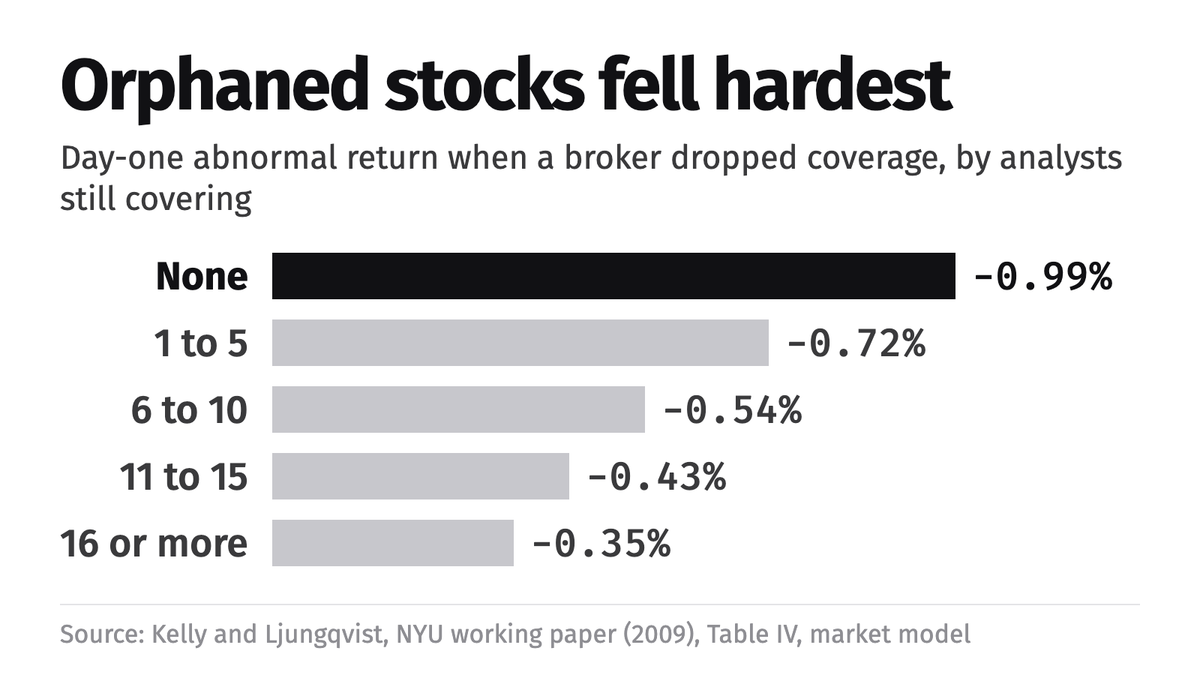
The size of the fall depended on how much information was left. Stocks with no other analyst covering them, which the authors call orphaned stocks, lost 0.99 percent on the day. Stocks still followed by more than 15 other analysts lost 0.35 percent6. Institutional investors, who can do their own research, bought: their share of the affected stocks rose from 61.9 percent to 62.9 percent6. Retail investors, who have fewer other sources of research, sold6. The authors show that prices fell because the affected stocks became more exposed to liquidity risk, and they estimate that expected returns rose by between 14 and 44 basis points a year6. A higher expected return means a higher cost of capital for the company, paid for through a lower share price.
Hiring someone to tell the story
If losing information lowers a stock's price, adding it should do the opposite. Brian Bushee and Gregory Miller tested that on small companies that began investor relations programs by hiring an outside IR firm7,8. They first interviewed IR professionals, who told them that the goal was almost always to attract institutional investors, and that "direct access to management, rather than increased disclosure, is viewed as the key driver of the strategy's success"7.
They then compared those companies with a matched sample of control firms. The IR companies showed "greater increases in institutional investor ownership and a shift toward investors that normally would not follow the companies," along with "greater improvements in analyst following, media coverage, and the book-to-price ratio"7. In the working-paper version, which studied 210 small and mid-cap companies, the new institutions tended to be more geographically distant and to invest in larger companies, and valuations improved in the year after the program began8. The IR firm's work reached investors who would otherwise never have looked.
The effect holds when companies build the function themselves. Marcus Kirk and James Vincent studied firms that started internal professional IR departments and found "increases in disclosure, analyst following, institutional investor ownership, liquidity, and market valuation relative to a matched sample of control firms"9. Their study also caught a regulatory shock. Regulation Fair Disclosure took away a potential channel of communication with investors, and afterward companies with established IR departments "more than doubled their level of public disclosure" and went on to gain analyst following, institutional investors and liquidity compared with similar companies that had no IR function9.
Rated, ranked and repriced
A third line of research measures the quality of the work itself. Vineet Agarwal, Richard Taffler, Xijuan Bellotti and Elly Nash used a proprietary database that rates IR quality across companies listed on the NYSE, Amex and Nasdaq5. Firms with higher-quality IR strategies "are rewarded with significantly higher valuation multiples," and improvements in IR quality went with increases in analyst following and liquidity5. The findings were "generally stronger for small firms which are more likely to be 'neglected'"5. The authors read this as evidence that effective IR raises a company's visibility, "leading to enhanced recognition and reduced information asymmetry" and a "'fairer' firm valuation as argued by IR professionals"5.
Visibility matters even when it comes from outside investor relations. Gustavo Grullon, George Kanatas and James Weston of Rice University looked at product advertising, which is aimed at customers, and found that "firms with greater advertising expenditures, ceteris paribus, have a larger number of both individual and institutional investors, and better liquidity of their common stock"10. Their paper opens with two famous pieces of investing advice, Peter Lynch's "Buy what you know" and Buffett's preference for great brands10. People buy shares in companies they have heard of, and the authors conclude that this familiarity "may affect its cost of capital and consequently its value"10.
Put together, these studies describe one mechanism from several angles. A company whose story is understood by more investors, and by the right investors, faces less uncertainty in its price, trades more easily, and pays less for capital. Take information away and the price falls. Add it, through analysts, an IR firm, an internal team or simply a better-known name, and the price tends to rise. The effect is largest for companies the market would otherwise overlook.
Paid to sound independent
The same evidence explains why investor relations attracts people who cut corners. If attention raises a stock's price, buying attention is tempting, and some companies have bought it dishonestly. On April 10, 2017, the Securities and Exchange Commission announced enforcement actions against 27 individuals and entities behind stock promotion schemes on investing websites11. Public companies had hired promoters or communications firms, which in turn hired writers to publish bullish articles without disclosing that the companies were paying for them11. More than 250 articles falsely stated that the writers had not been paid11.
The deception went further than silence. One writer used his own name and at least nine pseudonyms, including an invented persona who claimed to be "an analyst and fund manager with almost 20 years of investment experience," and one promotion firm had writers sign non-disclosure agreements barring them from revealing what they were paid11. The SEC charged three public companies and two of their chief executives, along with seven promotion or communications firms11. "Our markets cannot operate fairly when there are deliberate efforts to reach prospective investors with positive articles about a stock while hiding that the companies paid for those articles," said Melissa Hodgman of the SEC's enforcement division11.
Going quiet carries its own risk. Between 2002 and early 2005, many companies stopped issuing quarterly earnings guidance, and managers often cited a wish to reduce short-termism. Joel Houston, Baruch Lev and Jennifer Tucker studied 222 of them and found that "poor performance is the main reason for guidance cessation"12. Afterward, analyst forecast errors and dispersion rose, analyst coverage fell, and the stoppers curtailed other forward-looking disclosure instead of replacing the guidance12. The authors concluded that stopping guidance "does not benefit either the stoppers or their investors"12. Communication can narrow the gap between price and value. A weak business stays weak, and going quiet about it leaves the market knowing less.
Woodstock for Capitalists
Berkshire's own version of investor relations happens once a year in Omaha. In his 1996 letter, Buffett reported that the previous annual meeting had drawn 5,000 people and "strained the capacity of the Holiday Convention Centre," with shareholders from all 50 states and eight other countries3. Because the Class B shares had doubled the number of stockholders, he was moving the meeting to the Aksarben Coliseum, which held about 10,0003. "The annual meeting is a time for owners to get their business-related questions answered," he wrote, "and therefore Charlie and I will stay on stage until we start getting punchy"3.
The same letter showed what owners like that can bring. Richard Sercer, a Tucson aviation consultant, bought Berkshire stock in 1990 at his wife's urging, and the couple attended every annual meeting after that3. Sercer was also a long-time shareholder of FlightSafety International, and because he knew Berkshire's acquisition criteria, he thought the two companies would fit. He wrote to Bob Denham, chief executive of Salomon Inc, suggesting that he explore a merger, and in 1996 Berkshire bought FlightSafety, the world's leader in pilot training, for about $1.5 billion3. Buffett named Sercer and his wife, Alma Murphy, as "the heroes of this story"3.

The meeting kept growing into a gathering known as "Woodstock for Capitalists," where Buffett shared his views on markets, investing and life with shareholders from around the world13. At the 2025 meeting he said Berkshire's shareholder event the day before had drawn record attendance of nearly 20,000, and before the day was over he announced that he would ask the board to make Greg Abel chief executive by the end of the year, to a standing ovation13.
The lessons for public companies
Aim for a fair price. Buffett wanted Berkshire's stock "in a narrow range centered at intrinsic business value," and in 2003 the profession's own definition named "fair valuation" as the goal2,4. Buffett's case against an inflated price was that it rewards sellers at the expense of buyers and, in the end, stains the company's reputation3.
Information has a price effect you can measure. When research coverage disappeared for reasons unlikely to be related to the companies involved, their stocks fell and stayed down, and orphaned stocks fell furthest6. The less a market knows about a company, the more it charges that company for capital.
Visibility pays most where it is scarce. The gains from IR programs showed up most clearly in small and neglected companies, which gained institutional owners, analysts, liquidity and valuation7,9,5. For a company the market overlooks, investor relations can be the difference between being priced and being ignored.
Choose your shareholders. Berkshire designed an offering to repel quick flippers and attract long-term owners, and succeeded3. Bushee and Miller found that effective IR reaches investors "that normally would not follow the companies"7. Who owns the stock shapes how it trades.
Credibility is the asset. Promotion that hides who paid for it is fraud, and the SEC treats it that way11. Stopping communication when results turn bad leaves analysts less informed and coverage thinner12.
Say the uncomfortable thing. Berkshire's 1996 prospectus told buyers, on its cover, that the stock was not cheap. Thirty years later that page is still on file with the SEC1, and it still reads as a plain statement of what investor relations is for.
Sources
- 1
- 2
- 3
- 4
- 5
- 6
- 7
- 8
- 9
- 10
-
11
SEC: Payments for Bullish Articles on Stocks Must Be Disclosed to Investors, press release 2017-79, Apr 10, 2017
- 12
- 13

The AMW® Editorial Team covers marketing, business growth and the software AMW builds for businesses.
Frequently Asked Questions
Does investor relations affect a company's stock valuation?
Research says it does. Small companies that hired IR firms or built internal IR departments gained analyst following, institutional ownership, liquidity and valuation compared with matched peers, and companies with higher-rated IR programs trade at higher valuation multiples. The effect is strongest for small, less-visible companies.
What happens to a stock when analysts stop covering it?
In a study of 14,939 coverage terminations caused mostly by brokerage firms closing or cutting their research departments between 2000 and 2005, share prices fell on average by about half a percent on the day coverage ended. Stocks left with no other analyst fell 0.99 percent, and the losses had not reversed a month later.
What is the goal of investor relations?
In 2003 the National Investor Relations Institute defined investor relations as a strategic management responsibility that enables two-way communication between a company and the financial community and ultimately contributes to the company's securities achieving fair valuation.
Why did Berkshire Hathaway say its own stock was not undervalued?
In its May 1996 Class B prospectus, Berkshire said Warren Buffett and Charlie Munger would not buy the shares at the market price. Buffett wanted Berkshire's stock to trade close to the business's intrinsic value and to attract long-term owners, and the offering was designed to head off unit trusts that he believed would have created a speculative bubble in the stock.
Related Resources
Calculators
Case Studies
Related Articles
AI Answers Cite Your Press Before Your Founder Bio
AI models draw mostly on earned media, not brand-owned pages. Learn why press coverage shapes how your founder is described and how to write one press release line that carries over.
The Story of Polaroid: Edwin Land and the Instant Photo
A child's question in Santa Fe in 1943 became the SX-70, the Giant Polaroid and one of America's most admired brands. Then came Kodak, the phone and a factory set for demolition.

Nano Banana 2.1 Review: Spelling Right, Details Slip
We gave Google's Nano Banana 2.1 a bakery chalkboard sign and a candle product shot. It spelled every price correctly, then slipped on smaller details worth checking.