

The Earnings Call: What Enron, Tesla and the Research Reveal About Investor Relations' Most Watched Hour


In April 2001, Enron held a conference call to walk analysts through its first-quarter earnings, and a fund manager named Richard Grubman asked for something ordinary. Grubman, managing director of Highfields Capital Management in Boston, wanted to see Enron's balance sheet1. He was told it would not be available until the company filed with the Securities and Exchange Commission later that month. "You're the only financial institution that can't come up with balance sheet or cash flow statement after earnings," Grubman said1. Jeff Skilling, Enron's president and chief executive, answered, "Well, thank you very much, we appreciate that," and then, with a laugh, called Grubman a vulgar name on an open line1.

Quick Summary
Earnings conference calls carry information beyond the press release: trading volume jumps while they happen, and analysts who hear them forecast earnings more accurately3,4. Access was once restricted to invited analysts and large investors, and Regulation FD required material disclosures to be broadly available, which pushed companies to open them4,5,6. The question-and-answer session is the most informative part of a call8, which is why its management matters. Companies can choose which analysts to call on, and those that favor bullish analysts go on to report worse earnings surprises and more restatements7,15. Executives decline to answer about one analyst question in nine, and investors read silence as bad news13,14. Tesla's two calls of 2018 showed how quickly tone moves a stock9,10,12, and Enron's showed that the most important question on a call can be the one management least wants to hear1,2. For any investor relations team, the call is where credibility is earned or spent in public.
Skilling told Reuters afterward that he knew the microphone was on. "The specific fellow that I was not real happy with is a shortseller in the market," he said. "I don't think it is fair to our shareholders to give someone a platform like that"1. Grubman said he was "sort of at a loss as to why that was such an objectionable question"1. Enron's shares closed at $60 that day, up 56 cents, after better-than-expected results1. By December of that year the company was bankrupt2. The exchange raises the question this piece sets out to answer: what does an hour on the phone with management tell investors that a press release cannot, and what happens when management tries to control what gets asked?
A room full of large investors
By the mid-1990s the earnings call was common enough to study, and the first research asked who used it and whether it mattered3. Richard Frankel, Marilyn Johnson and Douglas Skinner found that companies holding calls were "larger, more profitable, go to the capital markets more often, and are growing more rapidly than other firms"3. The calls carried information "over and above the information contained in the accompanying press release"3. Trading volume rose while a call was in progress, and average trade size was higher, which the authors took as evidence "that material information is being released during conference calls and that a subset of large investors trade on this information in real time"3.
That subset was the problem. In 1998, as Robert Bowen, Angela Davis and Dawn Matsumoto recorded, "the SEC expressed concern that conference calls encourage selective disclosure by revealing new information to financial analysts privy to the call"4. Their study found that calls did make analysts better at forecasting earnings and helped weaker forecasters most, but because calls "were generally restricted during our sample period," they may also have "contributed to an information gap between analysts privy to the call and the remainder of the investment community"4.
Some companies opened their calls voluntarily. Brian Bushee, Dawn Matsumoto and Gregory Miller studied the firms that offered "unlimited real-time access" and found more small trades during the call, consistent with individuals trading on what they heard, along with higher price volatility5. Then Regulation FD required companies "to make material disclosures broadly available"6. Opponents of the rule worried that companies would say less. The same researchers found that the rule did discourage some firms from continuing to host calls, but "contrary to the concerns of many critics, the magnitudes of these changes are not large," and they found no evidence that less information came out during the calls6. The earnings call survived as a public event, and the questions became part of the record.
"Next up we'll hear from..."
Anyone who has listened to an earnings call knows the sound of the operator. What most listeners do not see is how the queue is run. In their study of conference call casting, Lauren Cohen, Dong Lou and Christopher Malloy describe an industry-standard system called Leader-View, and the provider InterCall, which they say administers over 85 percent of quarterly conference calls for Fortune 100 companies7. A company's "call-team," typically the chief executive and chief financial officer, the head of investor relations, legal counsel and two or three other executives, sees a screen listing everyone on the line, their affiliation and whether they have asked to speak7. Through a private line to the operator, the team chooses whom to call on and when, and decides when the question session ends7. "This is why conference call transcripts are filled with lines such as: 'Operator: Next up we'll hear from Colin Gillis from BGC Partners,'" the authors write7.
Analysts take the calls seriously. When Cohen, Lou and Malloy spoke to analysts, they described calling in, and asking a question if possible, as a "job-requirement," and one recalled a lead analyst whose absence from a call came up at his performance review7. The questions matter to everyone else too. Using more than 10,000 call transcripts, Dawn Matsumoto, Maarten Pronk and Erik Roelofsen found that both the prepared presentation and the discussion carry information beyond the press release, but that "discussion periods are relatively more informative than presentation periods," and more so when more analysts follow the company8. When performance is poor, managers talk more in the presentation, and still more information comes out in the questions8.
That is the context for Grubman's question. A balance sheet and a cash flow statement are where debt and cash show up. According to the Justice Department, Enron's top executives engaged in a scheme between at least 1999 and 2001 designed to make it appear "that Enron did not have significant write-offs or debt" and "that the company had an appropriate cash flow"2. On the call, the investor who pushed for the numbers was the one the chief executive did not want to give a platform.
"Boring bonehead questions are not cool"
Seventeen years later, a different chief executive gave investors a lesson in how much the tone of a call is worth. On May 2, 2018, Tesla held its first-quarter call. Around 32 minutes in, according to Fortune, the mood shifted9. Toni Sacconaghi of Sanford C. Bernstein asked a follow-up about Tesla's capital requirements for the rest of the year, and Elon Musk cut him off: "Excuse me. Next. Next. Boring bonehead questions are not cool. Next?"9. Joseph Spak of RBC Capital Markets asked about Model 3 reservations. "We're going to go to YouTube. Sorry. These questions are so dry. They're killing me," Musk said, and took questions instead from Galileo Russell, host of a YouTube channel, who had been invited onto the call to represent retail investors9.

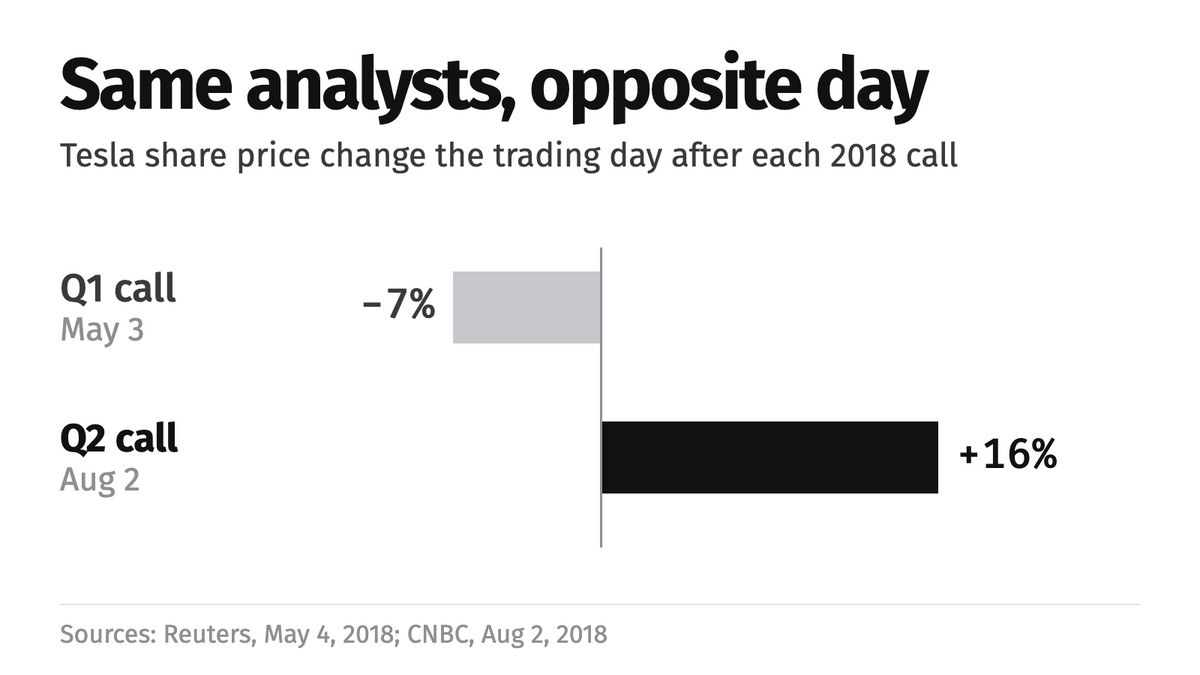
The questions Musk waved away were about money. Tesla's free cash flow had widened to negative $1 billion in the quarter, and the company had raised capital every year since going public10. Reuters reported that the refusal to answer drew sharp criticism and pushed the stock down 7 percent the next day10. Morgan Stanley's Adam Jonas said it was the most unusual call he had heard in 20 years in the business, and wrote a note titled "The Importance of 'Boring' Questions": "While they may be 'dry' in nature, we argue such questions are extremely important for a highly-levered and cash-hungry company"10. Spak said, "Investor feedback to the call was shock that a CEO would be dismissive and the general sentiment was that the defensiveness spoke volumes"10.
Three months later, on August 1, Tesla took its first questions on the second-quarter call from the same two analysts, and Musk apologized11,12. "My apologies for not being polite on the prior call," he said, blaming lack of sleep and overwork12. "I appreciate that," Sacconaghi replied. "Thank you"12. The shares rose 8.5 percent in after-hours trading, adding about $4.75 billion in market value, and closed up 16 percent the next day12. KeyBanc Capital Markets called it "maybe the most valuable apology of all time"12. The quarter's numbers also helped: Tesla backed its forecast of profits in the third and fourth quarters12. But the analysts' notes made clear that the tone counted. One wrote that "the CEO worked to restore some faith and credibility with investors"12.
Silence speaks
Musk's refusal was loud. Most refusals are quiet, and investors hear them anyway. Stephan Hollander, Maarten Pronk and Erik Roelofsen used the open nature of calls to study when managers withhold information, and found that "managers regularly leave participants on the conference call in the dark by not answering their questions"13. The best predictors included firm size, the chief executive's stock-price incentives, company age, performance and litigation risk13. They also found "strong support for the assumption maintained in the literature that investors interpret silence negatively. That is, investors seem to interpret no news as bad news"13.
Ian Gow, David Larcker and Anastasia Zakolyukina built a way to measure these moments across thousands of calls. By their count, "about 11% of analyst questions elicit non-answers from managers, a rate that is stable over time and similar across industries"14. Questions with a negative tone, more uncertainty or greater complexity, and requests for more detail, were more likely to get one14. So were questions about performance, and less so when the news was good14. A non-answer is a disclosure choice, and the market prices it as one.
Playing favorites
If executives can choose who asks the questions, some will choose friends. William Mayew studied transcripts from calls held after Regulation FD and found "that the probability of an analyst asking a question during an earnings conference call is increasing in the favorableness of the analyst's outstanding stock recommendation"15. Analysts who downgraded a stock lost access relative to others, though the effect held only for less prestigious analysts15. The findings, he wrote, "are consistent with practitioner and regulatory concerns that managers discriminate among analysts by allowing more management access to more favorable analysts"15.
Cohen, Lou and Malloy asked what happens next. Using US call transcripts from 2003 through early 2015, they found that "firms that 'cast' their conference calls by disproportionately calling on bullish analysts tend to underperform in the future"7. Those companies had more negative earnings surprises and more restatements; a one standard deviation increase in their casting measure predicted a 32 percent increase in the likelihood of a future restatement, relative to the normal rate7. A portfolio that bet against the casters and on the others earned abnormal returns "of up to 149 basis points per month, or almost 18 percent per year"7. The companies most likely to cast were those with higher discretionary accruals, those that barely met earnings expectations, and those, or whose executives, were "about to issue equity, sell shares, and exercise options"7.
That last detail echoes Enron. Grubman told Reuters that Skilling and his management team had sold 7 million shares the year before, "valued in the $70s and $80s"1. Enron did not need a casting system to keep the hard question away. The chief executive dismissed it in public.
What the voice gives away
Researchers have also listened to how executives speak. William Mayew and Mohan Venkatachalam ran call audio through vocal emotion analysis software and found that "when managers are scrutinized by analysts during conference calls, positive and negative affects displayed by managers are informative about the firm's financial future"16. Analysts did not use that information when forecasting near-term earnings, the authors found, and when changing recommendations they picked up positive affect but missed negative16.
David Larcker and Anastasia Zakolyukina studied the words. They labeled calls as truthful or deceptive using later financial restatements, then built models from word categories that psychological research links to deception17. The models did better than a random guess by 6 to 16 percent17. "The language of deceptive executives exhibits more references to general knowledge, fewer nonextreme positive emotions, and fewer references to shareholder value," they wrote, and "deceptive CEOs use significantly more extreme positive emotion and fewer anxiety words"17. A portfolio of the companies whose chief financial officers scored highest on deception produced an annualized alpha of between minus 4 and minus 11 percent17.
None of this makes a call a lie detector. It does mean that the hour is analyzed far beyond the numbers, by people who can trade on what they find, and that answers which sound smooth but say little are measurable.
The balance sheet question
Enron filed for bankruptcy in December 2001, and its stock became virtually worthless2. The Justice Department said the scheme had inflated the share price from about $30 in early 1998 to over $80 in January 2001 and artificially slowed its decline during the first three quarters of 2001, the period that included the April call2. On May 25, 2006, a federal jury in Houston convicted Skilling of 12 counts of securities fraud, one count of insider trading, conspiracy and five counts of making false statements to auditors; in October of that year he was sentenced to 24 years and four months in prison2. Kenneth Lay was convicted at the same trial2.
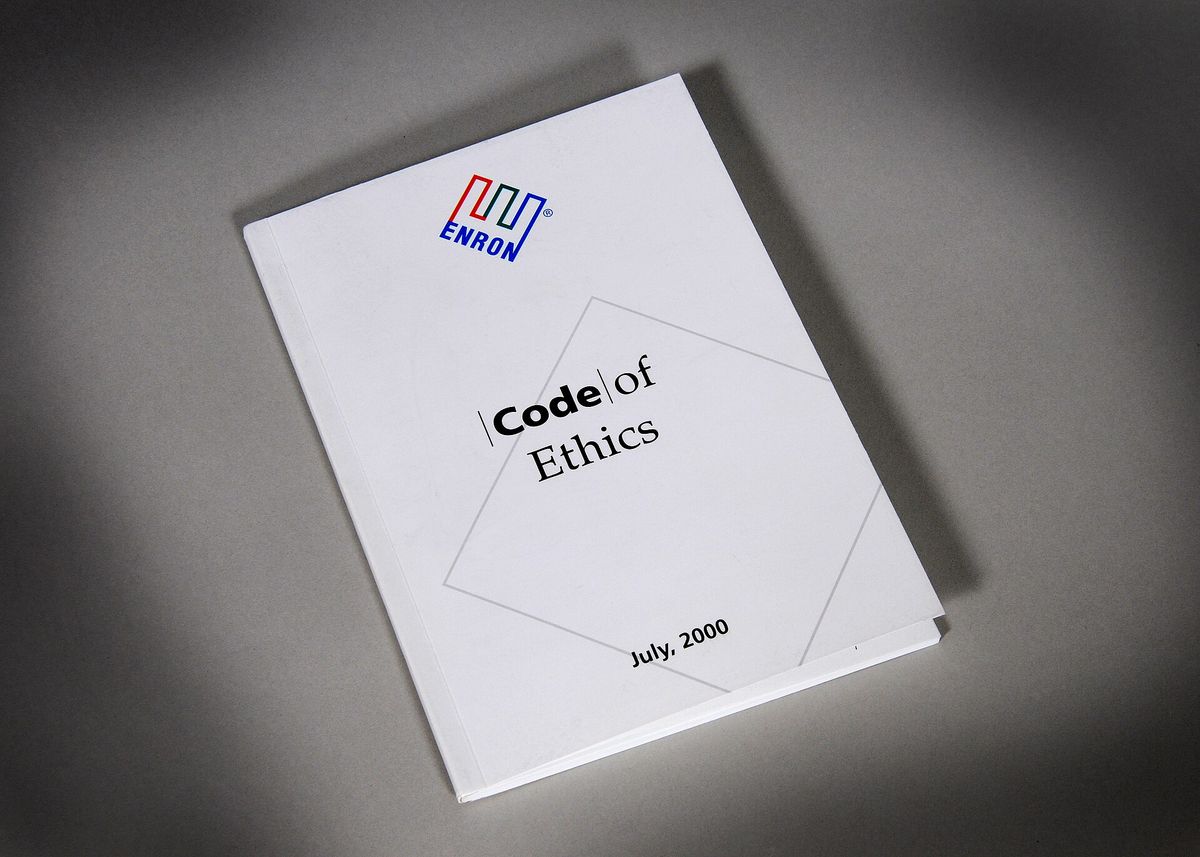
The FBI, which built the case with an Enron Task Force, keeps the company's Code of Ethics as an artifact of the investigation. The booklet, from 2000 and signed by chairman Kenneth Lay, tells employees that Enron "enjoys a reputation for fairness and honesty"18. Agents conducted more than 1,800 interviews and collected more than 3,000 boxes of evidence, and 22 people were convicted for their roles in the fraud18. The question that set off Skilling on the call was a request for the documents that would show debt and cash, and it was the right question.
The lessons for investor relations teams
The call carries information the release does not. Trading picks up while a call is live, analysts forecast better after hearing one, and the discussion is more informative than the script3,4,8. The call deserves the preparation of a disclosure document.
Answer the hard questions. About one analyst question in nine gets a non-answer, and investors treat silence as bad news13,14. A clear answer to an uncomfortable question costs less than a visible dodge.
Take questions from critics. Companies that favor bullish analysts go on to report more negative surprises and more restatements, and the market eventually prices that in7,15. Skilling dismissed Grubman as a short seller, and Grubman asked the most important question on Enron's call1.
Tone moves money. Tesla's stock fell after a dismissive call and rose sharply after an apology to the same analysts, with investors and analysts both citing credibility10,12. Executives should rehearse the manner as carefully as the numbers.
Words and voice are data. Researchers have shown that vocal cues and word choice on calls contain information about a company's future, and deceptive answers have measurable patterns16,17. The safest script is an accurate one.
Credibility outlasts a quarter. Enron's call ended with the stock up 56 cents1. The question it tried to brush aside was answered in a Houston courtroom five years later2.
Sources
-
1
Enron CEO Uses Vulgarity in Attack on Fund Manager, published by Fox News, Apr 18, 2001
- 2
- 3
- 4
- 5
- 6
-
7
Casting Conference Calls, working paper
- 8
- 9
-
10
Tesla faces angry Wall Street as Musk snubs 'boring' analysts, published by Business Standard, May 4, 2018
- 11
- 12
- 13
- 14
- 15
- 16
- 17
- 18
-
Header image

The AMW® Editorial Team covers marketing, business growth and the software AMW builds for businesses.
Frequently Asked Questions
What is an earnings conference call?
A call a public company holds with analysts and investors alongside its quarterly results, usually a prepared presentation by executives followed by questions. Research by Frankel, Johnson and Skinner found that calls provide information beyond the accompanying press release, with trading volume elevated while they take place.
Who chooses which analysts ask questions on an earnings call?
The company. Cohen, Lou and Malloy describe how a company's call team, typically the CEO, CFO, head of investor relations and legal counsel, sees who is waiting to ask a question and tells the operator whom to call on and when to end the session.
How often do executives avoid answering questions on earnings calls?
Gow, Larcker and Zakolyukina found that about 11 percent of analyst questions get non-answers, a rate stable over time and similar across industries. Hollander, Pronk and Roelofsen found that investors tend to interpret that silence as bad news.
What happened on Tesla's May 2018 earnings call?
Elon Musk cut off analysts asking about Tesla's capital needs and Model 3 reservations, calling their questions boring. Reuters reported the stock fell 7 percent the next day. On the next call in August he apologized to the same analysts, and CNBC reported the shares closed up 16 percent the following day.
Related Resources
Calculators
Case Studies
Related Articles
AI Answers Cite Your Press Before Your Founder Bio
AI models draw mostly on earned media, not brand-owned pages. Learn why press coverage shapes how your founder is described and how to write one press release line that carries over.
The Story of Polaroid: Edwin Land and the Instant Photo
A child's question in Santa Fe in 1943 became the SX-70, the Giant Polaroid and one of America's most admired brands. Then came Kodak, the phone and a factory set for demolition.

Nano Banana 2.1 Review: Spelling Right, Details Slip
We gave Google's Nano Banana 2.1 a bakery chalkboard sign and a candle product shot. It spelled every price correctly, then slipped on smaller details worth checking.